From Tangent Circles to Infinite Series & Binary Factoring
This session bridges geometry and algebra in a surprising way. Starting with a simple question about tangent circles, we discover a formula that leads us into the world of infinite series — sums that never end but can still equal a finite number. Along the way, we encounter a beautiful connection to binary numbers and learn how to factor infinite polynomials. These ideas form the foundation of calculus and appear throughout competition mathematics (including the AMC/AIME).
Topics Covered
- Distance between tangent points of two circles on a line
- Introduction to infinite series and convergence
- Geometric series: closed-form formula
- AMC 2015 12A Problem 25 (circle packing)
- Factoring geometric series as infinite products
- Binary representation and uniqueness
Lecture Video
Key Video Frames
Prerequisites
Two circles are tangent to each other when they touch at exactly one point. If they touch on the outside, we call them externally tangent — the distance between their centers equals the sum of their radii.
A circle is tangent to a line when it touches the line at exactly one point. At that point, the radius is perpendicular to the line.
A sequence is an ordered list of numbers: \(a_1, a_2, a_3, \ldots\)
A series is the sum of the terms of a sequence:
\[S = a_1 + a_2 + a_3 + \cdots\]
If the sequence has finitely many terms, it is a finite series. If it goes on forever, it is an infinite series.
An infinite series converges if its partial sums approach a fixed number. Otherwise it diverges.
In our usual decimal system, we express numbers using powers of 10. In binary, we use powers of 2.
For example, \(13 = 8 + 4 + 1 = 2^3 + 2^2 + 2^0\), so in binary: \(13_{10} = 1101_2\).
Every positive integer has a unique binary representation.
Key Concepts
Tangent-circle distance formula: If two circles of radii \(r\) and \(R\) are both tangent to the same line and externally tangent to each other, the distance between their tangent points on the line is \(s = 2\sqrt{rR}\).
Geometric series (infinite): \(\displaystyle \sum_{k=0}^{\infty} x^k = \frac{1}{1-x}\) for \(|x| < 1\).
Geometric series (finite): \(\displaystyle \sum_{k=0}^{n} x^k = \frac{x^{n+1} - 1}{x - 1}\).
Binary factoring: \(\displaystyle 1 + x + x^2 + x^3 + \cdots = (1+x)(1+x^2)(1+x^4)(1+x^8)\cdots\)
1. Distance Between Tangent Points on a Line
The Setup
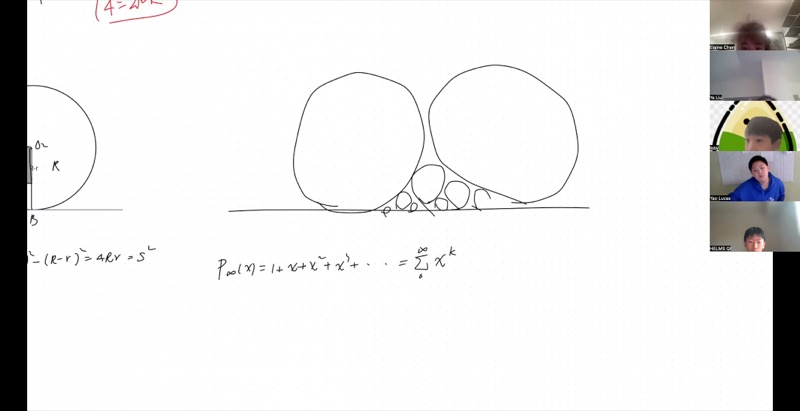
Two circles with radii \(r\) (small) and \(R\) (big) both sit on a flat line (both tangent to the line from above) and are externally tangent to each other. What is the horizontal distance \(s\) between the two points where the circles touch the line?
The Trapezoid Construction
Connect the centers of the two circles. This gives a line segment of length \(r + R\) (since they are externally tangent).
Now draw horizontal and vertical reference lines from the centers to form a right triangle:
- The vertical leg is the difference of the radii: \(R - r\)
- The hypotenuse is the center-to-center distance: \(R + r\)
- The horizontal leg is the distance between tangent points: \(s\)
By the Pythagorean theorem:
\[s^2 + (R - r)^2 = (R + r)^2\]
Expanding:
\[s^2 = (R+r)^2 - (R-r)^2 = 4Rr\]
Therefore:
\[\boxed{s = 2\sqrt{Rr}}\]
Drag the sliders for \(r\) and \(R\) to observe how the tangent-point distance changes.
Example: Toby’s Opening Problem
Two circles are both tangent to a wedge formed by two lines meeting at a point. The distances from the vertex to each tangent point are both 4. The problem is to find the area of the smaller circle.
Using the tangent-line properties and the construction above, if the distance between tangent points is 4, and the ratio of the radii is \(r : 2r\), then:
\[4 = 2\sqrt{r \cdot 2r} = 2r\sqrt{2}\]
Solving: \(r = \sqrt{2}\)
Area of the small circle: \(\pi r^2 = 2\pi\).
2. Introduction to Infinite Series
From Polynomials to Power Series
A polynomial has finitely many terms. But what if we allow infinitely many terms?
\[P(x) = 1 + x + x^2 + x^3 + \cdots = \sum_{k=0}^{\infty} x^k\]
This is called a power series — an “infinite-degree polynomial.”
Deriving the Closed Form
Let \(S = 1 + x + x^2 + x^3 + \cdots\)
Multiply both sides by \(x\):
\[xS = x + x^2 + x^3 + x^4 + \cdots\]
Subtract:
\[S - xS = 1\]
\[S(1 - x) = 1\]
\[\boxed{S = \frac{1}{1-x}}\]
This is a formal identity. It is numerically valid only when \(|x| < 1\) (so the series converges). For example:
- \(x = \tfrac{1}{2}\): \(1 + \tfrac{1}{2} + \tfrac{1}{4} + \cdots = \frac{1}{1 - 1/2} = 2\) — correct!
- \(x = 2\): \(1 + 2 + 4 + \cdots = \frac{1}{1-2} = -1\) — absurd! (The series diverges.)
Sanity check: Multiply \((1 + x + x^2 + \cdots) \times (1 - x)\). Every term cancels except the leading \(1\).
Finite Geometric Series
For a finite sum, the leftover final term matters:
\[S_n = \sum_{k=0}^{n} x^k = 1 + x + x^2 + \cdots + x^n\]
Multiply by \(x\) and subtract:
\[S_n - xS_n = 1 - x^{n+1}\]
\[\boxed{S_n = \frac{x^{n+1} - 1}{x - 1}}\]
This formula works for any \(x \neq 1\), even when \(|x| > 1\), because the sum is finite.
Adjust \(a\) (the common ratio) and \(n\) (number of terms) to observe how the finite partial sum approaches the infinite sum.
3. AMC 2015 12A Problem 25: Circle Packing
The Problem
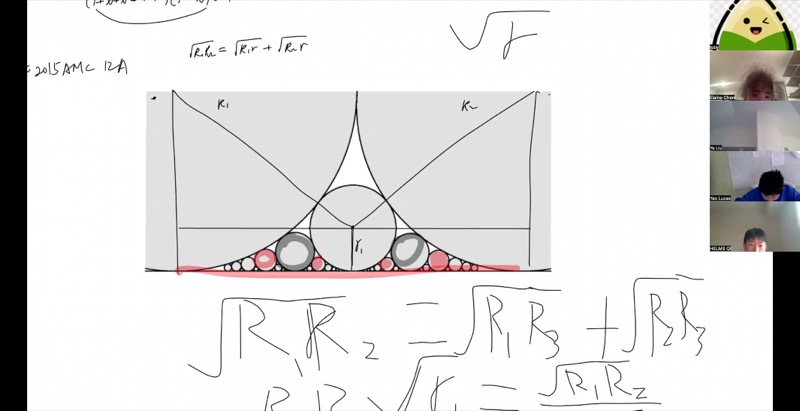
A collection of circles is packed between two large circles of radii \(R_1\) and \(R_2\), all tangent to the same line. Circles are inserted layer by layer: the first layer (\(L_1\)) has one circle between \(R_1\) and \(R_2\), the second layer (\(L_2\)) has two circles, the third (\(L_3\)) has four, and so on — layer \(L_k\) has \(2^{k-1}\) circles.
The problem asks for the sum \(\sum \frac{1}{\sqrt{r_i}}\) over all the small circles through the first six layers.
Finding \(r_1\): The First Inserted Circle
A circle of radius \(r_1\) is inserted between the two original circles, tangent to all three (both large circles and the base line).
Using our tangent-point distance formula:
\[2\sqrt{R_1 R_2} = 2\sqrt{R_1 r_1} + 2\sqrt{R_2 r_1}\]
Divide both sides by \(2\sqrt{r_1}\):
\[\frac{\sqrt{R_1 R_2}}{\sqrt{r_1}} = \sqrt{R_1} + \sqrt{R_2}\]
Therefore:
\[\frac{1}{\sqrt{r_1}} = \frac{\sqrt{R_1} + \sqrt{R_2}}{\sqrt{R_1 R_2}} = \frac{1}{\sqrt{R_1}} + \frac{1}{\sqrt{R_2}}\]
This is the crucial insight: the quantity \(\frac{1}{\sqrt{r}}\) of each new circle equals the sum of \(\frac{1}{\sqrt{r}}\) from its two neighboring circles.
The Layer Pattern
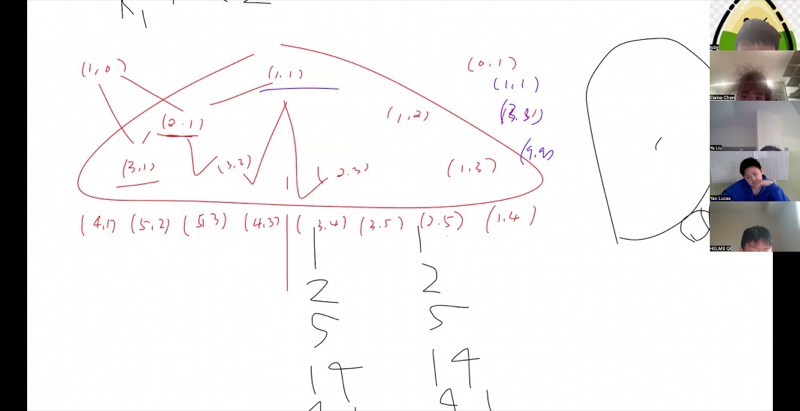
This additive property means each new circle’s \(\frac{1}{\sqrt{r}}\) value is a sum of copies of \(\frac{1}{\sqrt{R_1}}\) and \(\frac{1}{\sqrt{R_2}}\). Tracking the number of copies of each:
| Layer | Circles (copies of \(\frac{1}{\sqrt{R_1}}\), \(\frac{1}{\sqrt{R_2}}\)) | Total copies of each |
|---|---|---|
| \(L_0\) (original) | \((1, 0)\) and \((0, 1)\) | 1, 1 |
| \(L_1\) | \((1, 1)\) | 1, 1 |
| \(L_2\) | \((2, 1)\) and \((1, 2)\) | 3, 3 |
| \(L_3\) | \((3, 1), (3, 2), (2, 3), (1, 3)\) | 9, 9 |
| \(L_k\) | … | \(3^{k-1}\), \(3^{k-1}\) |
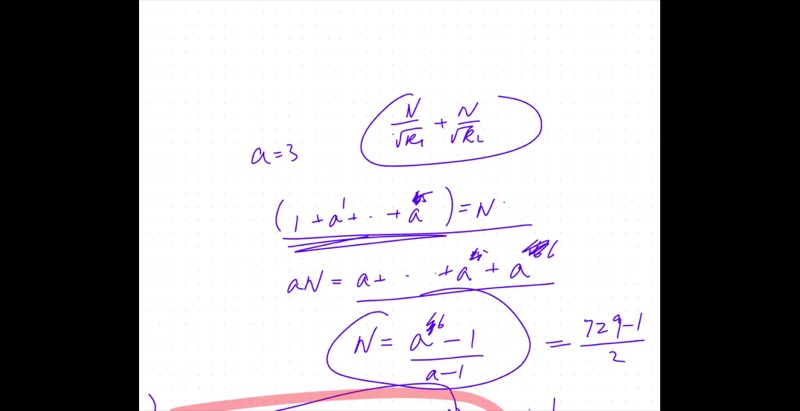
The total copies on each layer follow powers of 3! So the sum across all six layers is:
\[\sum_{k=1}^{6} 3^{k-1} = \frac{3^6 - 1}{3 - 1} = \frac{729 - 1}{2} = 364\]
And the final answer is:
\[364 \left(\frac{1}{\sqrt{R_1}} + \frac{1}{\sqrt{R_2}}\right)\]
When you insert a new layer, each new circle is formed between two adjacent existing circles. Its copy-count is the sum of its neighbors’. At the boundaries, the original large circles always contribute \((1,0)\) or \((0,1)\).
Adding up all the copy-counts in a layer and comparing to the previous layer, the total multiplies by 3. This can be proven by induction.
4. Factoring a Geometric Series: The Binary Connection
Lucas’s Brilliant Observation
The infinite geometric series can be written as an infinite product:
\[1 + x + x^2 + x^3 + \cdots = (1+x)(1+x^2)(1+x^4)(1+x^8) \cdots\]
When you expand the right side, each term in the product contributes either \(1\) or \(x^{2^j}\). A typical term in the expansion is:
\[x^{2^{a_1}} \cdot x^{2^{a_2}} \cdots = x^{2^{a_1} + 2^{a_2} + \cdots}\]
The exponent is a sum of distinct powers of 2 — which is exactly a binary number! Since every non-negative integer has a unique binary representation, every power \(x^n\) appears exactly once.
Proving Binary Uniqueness
Claim: Every positive integer has a unique representation as a sum of distinct powers of 2.
Proof: Suppose some integer \(N\) has two different binary representations. Consider the largest power of 2 in each.
If they differ, say one uses \(2^k\) and the other doesn’t, then the one without \(2^k\) must make up the difference using only powers \(2^0, 2^1, \ldots, 2^{k-1}\). But \(2^0 + 2^1 + \cdots + 2^{k-1} = 2^k - 1 < 2^k\), so it is impossible.
Therefore, both representations must use the same largest power. Remove it from both, and repeat the argument for the remainder.
By induction, the representations are identical. \(\square\)
This is the key fact: the sum of all smaller powers of 2 is still less than the next power: \(1 + 2 + 4 + \cdots + 2^{k-1} = 2^k - 1\).
Example: Which Factors Produce \(x^{101}\)?
Write 101 in binary:
\[101 = 64 + 32 + 4 + 1 = 2^6 + 2^5 + 2^2 + 2^0\]
So \(101_{10} = 1100101_2\).
From the product, select \(x^{64}\) from \((1+x^{64})\), \(x^{32}\) from \((1+x^{32})\), \(x^{4}\) from \((1+x^{4})\), and \(x^{1}\) from \((1+x)\). Select \(1\) from all other factors.
\[x^1 \cdot 1 \cdot x^4 \cdot 1 \cdot x^{32} \cdot x^{64} \cdot 1 \cdots = x^{101}\]
This combination is unique, so \(x^{101}\) appears with coefficient exactly 1.
5. Application: Parity of Binomial Coefficients
Cheat Sheet
| Formula | Expression |
|---|---|
| Tangent-point distance | \(s = 2\sqrt{rR}\) for two circles of radii \(r, R\) on a line |
| Infinite geometric series | \(\displaystyle\sum_{k=0}^{\infty} x^k = \frac{1}{1-x}\), valid for \(\lvert x\rvert < 1\) |
| Finite geometric series | \(\displaystyle\sum_{k=0}^{n} x^k = \frac{x^{n+1}-1}{x-1}\) |
| Binary product factoring | \((1+x)(1+x^2)(1+x^4)\cdots = 1 + x + x^2 + x^3 + \cdots\) |
| Binary uniqueness | Every positive integer has a unique binary representation |
| Parity of \(\binom{m}{n}\) | Odd iff every binary digit of \(n \leq\) corresponding digit of \(m\) |
The Geometric Series Trick (Memorize This!)
To sum \(S = 1 + a + a^2 + \cdots + a^n\):
- Multiply by \(a\): \(aS = a + a^2 + \cdots + a^{n+1}\)
- Subtract: \(aS - S = a^{n+1} - 1\)
- Solve: \(\displaystyle S = \frac{a^{n+1} - 1}{a - 1}\)