Completing the Square, Discriminant & Conic Section Classification
Lecture Video
Key Video Frames
Background
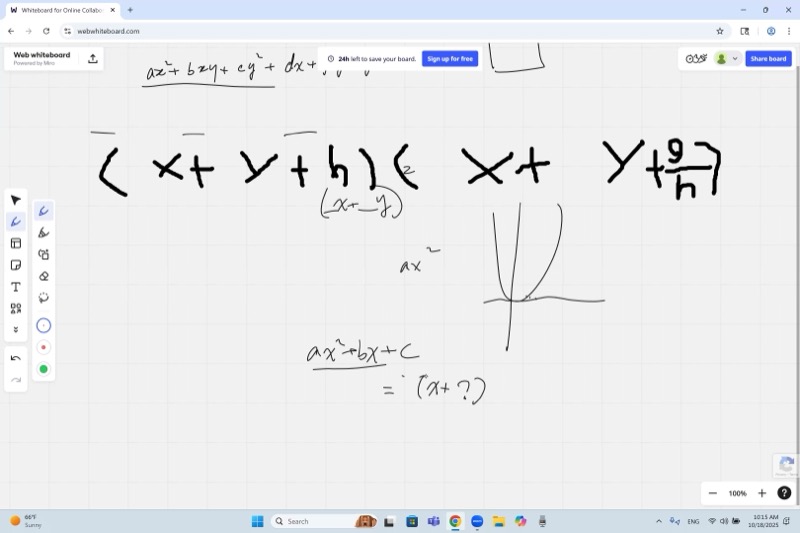
In earlier sessions we studied conic sections from multiple perspectives: their geometric definitions using foci and directrices, and the physical picture of slicing a cone. This lesson returns to the algebraic perspective. Starting from the general second-degree equation in two variables, we ask: how do the coefficients alone tell you what shape the graph is?
Along the way we revisit completing the square for a single-variable quadratic, re-derive the quadratic formula, and then extend the same discriminant idea to classify two-variable quadratic forms as ellipses, hyperbolas, or degenerate cases (pairs of lines, parabolas).
- Completing the square rewrites \(ax^2 + bx + c\) as \(a\!\left(x + \frac{b}{2a}\right)^2 + \frac{4ac - b^2}{4a}\), revealing the vertex and axis of symmetry.
- The quadratic formula \(x = \frac{-b \pm \sqrt{b^2 - 4ac}}{2a}\) is a direct consequence of completing the square.
- For the general conic \(ax^2 + bxy + cy^2 + dx + ey + f = 0\), only the quadratic coefficients \(a\), \(b\), \(c\) determine the type of curve; the linear terms \(d\), \(e\), \(f\) only shift its position.
- The discriminant \(\Delta = b^2 - 4ac\) classifies the conic:
- \(\Delta < 0\) : ellipse (or circle)
- \(\Delta = 0\) : parabola
- \(\Delta > 0\) : hyperbola (two distinct linear factors \(\Rightarrow\) two asymptotes)
- When the quadratic part factors into two identical linear factors (\(\Delta = 0\)), the conic degenerates; when it factors into two distinct linear factors (\(\Delta > 0\)), the factor lines become asymptotes of a hyperbola.
1. Review: The General Conic Equation
Every conic section can be written in the form
\[ax^2 + bxy + cy^2 + dx + ey + f = 0\]
where \(a, b, c, d, e, f\) are real constants. This single equation can represent a circle, ellipse, parabola, hyperbola, a pair of lines, or even a single point, depending on the coefficients.
Consider the single-variable analogy. The graphs of \(y = x^2\) and \(y = x^2 + 6x + 11\) are identical parabolas – the second is just the first shifted to a new location:
\[x^2 + 6x + 11 = (x+3)^2 + 2\]
The linear coefficient \(6\) and constant \(11\) produce a horizontal shift of \(-3\) and a vertical shift of \(+2\), but the shape (how wide, how narrow) is determined solely by the leading coefficient \(1\).
The same principle holds in two variables. The terms \(dx + ey + f\) translate the curve but do not change whether it is an ellipse or a hyperbola. Only \(a\), \(b\), \(c\) (the quadratic part) determine the type.
2. Completing the Square – Single Variable
Given a quadratic \(y = ax^2 + bx + c\) with \(a \neq 0\):
Step 1. Factor out the leading coefficient from the \(x\)-terms:
\[y = a\!\left(x^2 + \frac{b}{a}x\right) + c\]
Step 2. Complete the square inside the parentheses using half the linear coefficient:
\[y = a\!\left(x + \frac{b}{2a}\right)^2 - \frac{b^2}{4a} + c\]
Step 3. Combine the constants:
\[\boxed{y = a\!\left(x + \frac{b}{2a}\right)^2 + \frac{4ac - b^2}{4a}}\]
Step 1. Factor out \(3\):
\[y = 3\!\left(x^2 + 4x\right) + 7\]
Step 2. Half of \(4\) is \(2\). Write \((x+2)^2 = x^2 + 4x + 4\), so we added \(4\) inside:
\[y = 3\!\left(x + 2\right)^2 - 3 \cdot 4 + 7 = 3(x+2)^2 - 5\]
Result: Vertex at \((-2, -5)\), axis of symmetry \(x = -2\), opens upward since \(a = 3 > 0\).
A frequent error is trying to accommodate the constant \(c\) instead of the linear coefficient \(b\). Remember: always match the linear term \(\frac{b}{a}x\), not the constant. The constant is what gets adjusted at the end.
If \(y = ax^2 + bx + c\), you complete the square on the coefficient of \(x\), which is \(\frac{b}{a}\), taking half of it: \(\frac{b}{2a}\).
Reading the Graph from Vertex Form
From \(y = a(x - h)^2 + k\):
| Feature | Value |
|---|---|
| Vertex | \((h, k)\) |
| Axis of symmetry | \(x = h = -\frac{b}{2a}\) |
| Opens upward/downward | \(a > 0\) (up) / \(a < 0\) (down) |
| Width/narrowness | Determined solely by \(|a|\) |
Drag the sliders to see how \(a\) controls shape, while \(h\) and \(k\) only shift the parabola.
3. Deriving the Quadratic Formula
Start with \(ax^2 + bx + c = 0\) where \(a \neq 0\).
From completing the square we already have:
\[a\!\left(x + \frac{b}{2a}\right)^2 + \frac{4ac - b^2}{4a} = 0\]
Rearrange:
\[a\!\left(x + \frac{b}{2a}\right)^2 = \frac{b^2 - 4ac}{4a}\]
Divide both sides by \(a\):
\[\left(x + \frac{b}{2a}\right)^2 = \frac{b^2 - 4ac}{4a^2}\]
Take the square root (remember \(\pm\)):
\[x + \frac{b}{2a} = \pm\,\frac{\sqrt{b^2 - 4ac}}{2a}\]
Isolate \(x\):
\[\boxed{x = \frac{-b \pm \sqrt{b^2 - 4ac}}{2a}}\]
The expression \(\Delta = b^2 - 4ac\) under the square root is the discriminant. It tells you whether the quadratic has two real roots (\(\Delta > 0\)), one repeated root (\(\Delta = 0\)), or no real roots (\(\Delta < 0\)).
4. Constructing a Quadratic from Points
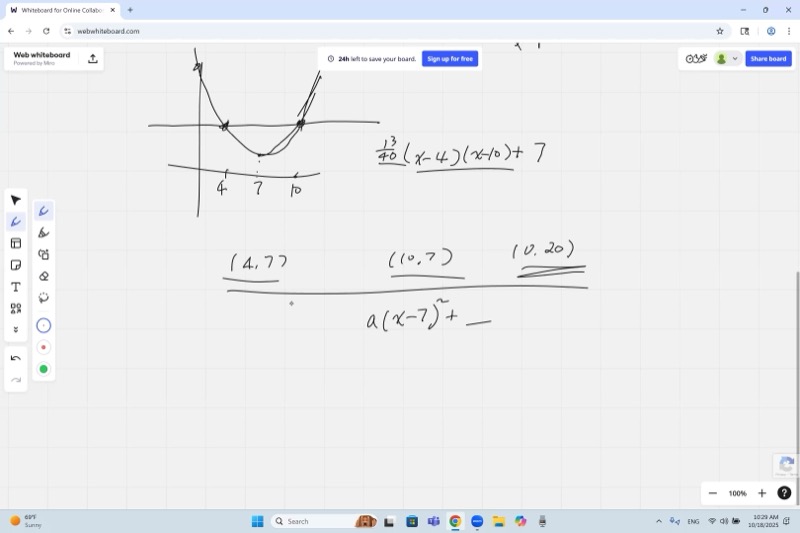
Step 1. Spot the axis of symmetry. The points \((4, 7)\) and \((10, 7)\) share the same \(y\)-value, so the axis of symmetry lies halfway between them:
\[x = \frac{4 + 10}{2} = 7\]
Step 2. Write vertex form. We know the parabola has the form:
\[y = a(x - 7)^2 + k\]
Step 3. Use a symmetric pair to find \(k\). Plug in \((4, 7)\):
\[7 = a(4 - 7)^2 + k = 9a + k\]
Step 4. Use the third point. Plug in \((0, 20)\):
\[20 = a(0 - 7)^2 + k = 49a + k\]
Step 5. Solve the system. Subtract: \(20 - 7 = 49a - 9a\), giving \(13 = 40a\), so \(a = \frac{13}{40}\).
Then \(k = 7 - 9 \cdot \frac{13}{40} = 7 - \frac{117}{40} = \frac{163}{40}\).
\[y = \frac{13}{40}(x - 7)^2 + \frac{163}{40}\]
Shortcut via factored form. Since the axis is at \(x = 7\), shifting the parabola down by \(7\) puts the roots at \(x = 4\) and \(x = 10\). So:
\[y - 7 = a(x - 4)(x - 10)\]
Plug in \((0, 20)\): \(\;13 = a(-4)(-10) = 40a\), giving \(a = \frac{13}{40}\). Done in seconds.
5. Classifying Conics with the Discriminant
Now we extend the discriminant idea to two variables. Consider just the quadratic part of the general conic:
\[ax^2 + bxy + cy^2\]
To classify the conic, treat this as a quadratic in \(x\) (with \(y\) as a parameter) and examine whether it factors into two linear expressions:
\[ax^2 + bxy + cy^2 = a\!\left(x - r_1 y\right)\!\left(x - r_2 y\right)\]
This factorization exists over the reals precisely when the discriminant
\[\Delta = b^2 - 4ac\]
is non-negative.
The Classification Table
| Discriminant | Factorability | Conic type |
|---|---|---|
| \(b^2 - 4ac < 0\) | Does not factor over reals | Ellipse (or circle if \(a = c\), \(b = 0\)) |
| \(b^2 - 4ac = 0\) | Factors into identical linear factors | Parabola (degenerate: one line or parallel lines) |
| \(b^2 - 4ac > 0\) | Factors into two distinct linear factors | Hyperbola (degenerate: two intersecting lines) |
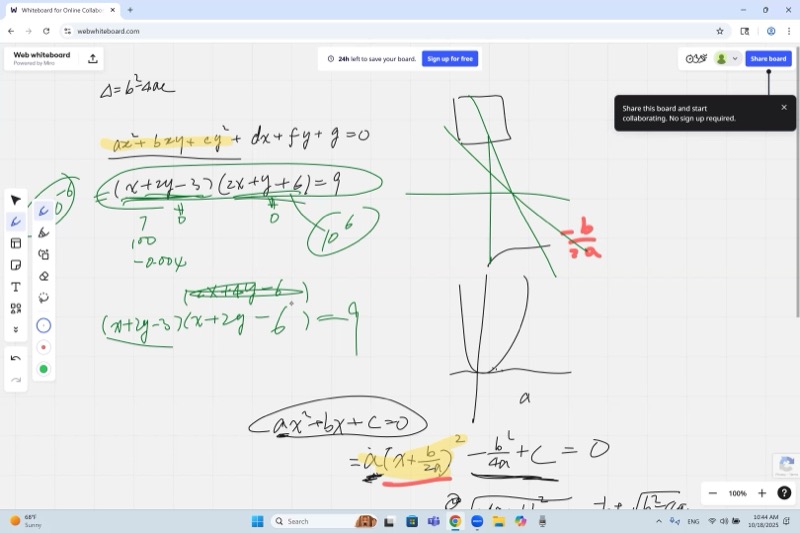
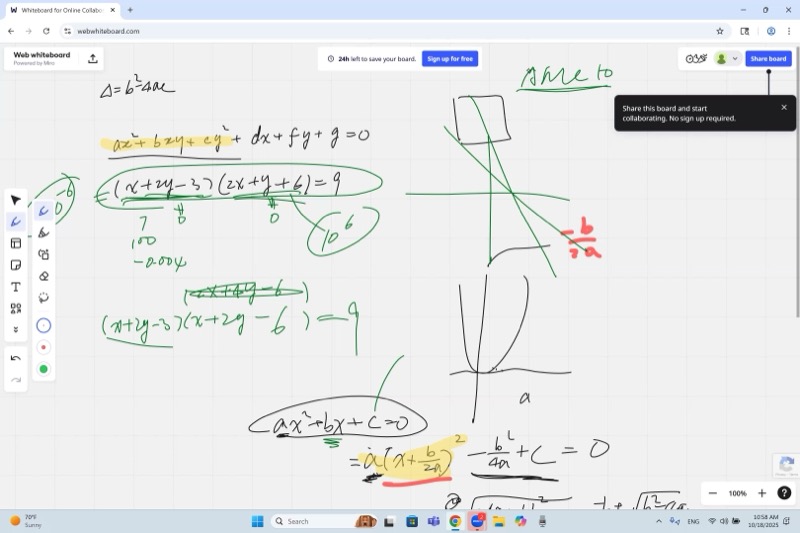
Suppose the quadratic part factors as \((px + qy)(rx + sy)\) with the two factors being genuinely different lines. Then the full conic equation looks something like:
\[(px + qy + \alpha)(rx + sy + \beta) = k\]
For any nonzero constant \(k\), neither factor can be zero – they are untouchable. But one factor can be made arbitrarily small while the other grows arbitrarily large, so the curve approaches both lines \(px + qy + \alpha = 0\) and \(rx + sy + \beta = 0\) without ever touching them.
Those two lines are the asymptotes of a hyperbola.
Now, if the two factors happen to be parallel (scalar multiples of each other, like \(x + 2y\) and \(2x + 4y\)), then one factor being tiny forces the other to also be tiny – you can no longer have one approach infinity while the other approaches zero. In that degenerate case (\(\Delta = 0\)), you do not get a hyperbola.
Compute the discriminant of the quadratic part:
\[\Delta = b^2 - 4ac = 5^2 - 4(2)(2) = 25 - 16 = 9 > 0\]
Since \(\Delta > 0\), this is a hyperbola. The quadratic part factors:
\[2x^2 + 5xy + 2y^2 = (2x + y)(x + 2y)\]
The lines \(2x + y = \text{const}\) and \(x + 2y = \text{const}\) are the asymptotic directions.
Compute the discriminant:
\[\Delta = 2^2 - 4(1)(1) = 4 - 4 = 0\]
Since \(\Delta = 0\), the quadratic part factors into identical factors:
\[x^2 + 2xy + y^2 = (x + y)^2\]
This is a degenerate conic – either a parabola or a pair of coincident/parallel lines, depending on the remaining terms.
Compute the discriminant:
\[\Delta = 1^2 - 4(1)(1) = 1 - 4 = -3 < 0\]
Since \(\Delta < 0\), this is an ellipse. The quadratic form \(x^2 + xy + y^2\) cannot be factored over the reals into two linear expressions.
6. From Factored Form to Asymptotes – A Concrete Picture
The dashed lines are the asymptotes. The hyperbola approaches them but never touches them. If the two factor-lines were identical, the curve would collapse into a parabola or degenerate case instead.
7. Connecting Single-Variable and Two-Variable Discriminants
Notice the beautiful parallel:
| Single variable: \(ax^2 + bx + c = 0\) | Two variables: \(ax^2 + bxy + cy^2\) | |
|---|---|---|
| Discriminant | \(b^2 - 4ac\) | \(b^2 - 4ac\) |
| \(\Delta > 0\) | Two distinct real roots | Factors into two distinct lines \(\to\) hyperbola |
| \(\Delta = 0\) | One repeated root | Identical factors \(\to\) parabola / degenerate |
| \(\Delta < 0\) | No real roots | Cannot factor \(\to\) ellipse |
This is not a coincidence. Classifying the two-variable quadratic form \(ax^2 + bxy + cy^2\) is equivalent to solving \(at^2 + bt + c = 0\) where \(t = x/y\), and the discriminant is identical.
Cheat Sheet
| What you need | Formula / Method |
|---|---|
| Complete the square | \(ax^2 + bx + c = a\!\left(x + \frac{b}{2a}\right)^2 + \frac{4ac - b^2}{4a}\) |
| Axis of symmetry | \(x = -\frac{b}{2a}\) |
| Quadratic formula | \(x = \frac{-b \pm \sqrt{b^2 - 4ac}}{2a}\) |
| Discriminant (1 var) | \(\Delta = b^2 - 4ac\): positive \(\to\) 2 roots, zero \(\to\) 1 root, negative \(\to\) 0 real roots |
| Conic type (2 vars) | From \(ax^2 + bxy + cy^2\): compute \(\Delta = b^2 - 4ac\) |
| Ellipse | \(\Delta < 0\) (cannot factor) |
| Parabola / degenerate | \(\Delta = 0\) (repeated factor) |
| Hyperbola | \(\Delta > 0\) (two distinct factors \(\to\) two asymptotes) |
| Shape vs. position | Only \(a, b, c\) determine shape; \(d, e, f\) only shift |
| Find quadratic from points | Use axis of symmetry from matching \(y\)-values, then factored or vertex form |
Quick Completing-the-Square Recipe
\[y = ax^2 + bx + c\]
- Factor out \(a\): \(\;y = a\!\left(x^2 + \frac{b}{a}x\right) + c\)
- Half the inner coefficient: \(\;\frac{b}{2a}\)
- Write the square: \(\;\left(x + \frac{b}{2a}\right)^2\)
- Subtract what you added: \(\;y = a\!\left(x + \frac{b}{2a}\right)^2 + c - \frac{b^2}{4a}\)
Conic Classification at a Glance
\[ax^2 + bxy + cy^2 + dx + ey + f = 0 \quad\xrightarrow{\;\Delta = b^2 - 4ac\;}\quad \begin{cases} \Delta < 0 & \text{ellipse} \\ \Delta = 0 & \text{parabola} \\ \Delta > 0 & \text{hyperbola} \end{cases}\]