Factoring Quadratic Forms, Eigenvalues & Conic Section Classification
Conic sections – ellipses, hyperbolas, and parabolas – show up throughout science and engineering:
- Planetary orbits follow ellipses (Kepler’s first law)
- GPS and radar use hyperbolas to triangulate positions
- Telescope mirrors are parabolic to focus light to a single point
- Earthquake detection uses hyperbolas from arrival-time differences at stations
In this lesson, we learn how to take any second-degree equation in two variables and classify it instantly using just three numbers – no graphing required!
Topics Covered
- Factoring the general quadratic form \(ax^2 + bxy + cy^2\)
- Connection between single-variable and two-variable factoring
- Eigenvalues \(\lambda_1, \lambda_2\) as roots of the characteristic equation
- Discriminant test: \(b^2 - 4ac\) classifies conics
- Absorbing linear terms into factored form
- Coordinate transformation and rotation of axes for parabolas
Lecture Video
Key Video Frames
Prerequisites
For a single-variable quadratic \(ax^2 + bx + c = 0\), the two roots are:
\[x = \frac{-b \pm \sqrt{b^2 - 4ac}}{2a}\]
The expression \(\Delta = b^2 - 4ac\) is called the discriminant. It tells us the nature of the roots:
- \(\Delta > 0\): two distinct real roots
- \(\Delta = 0\): one repeated (double) root
- \(\Delta < 0\): no real roots (complex roots)
If a quadratic \(ax^2 + bx + c\) has roots \(x_1\) and \(x_2\), then it factors as:
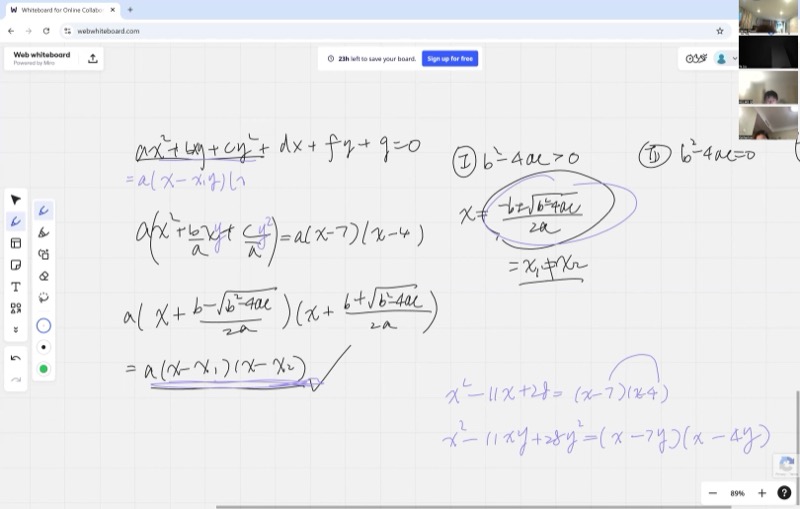
\[ax^2 + bx + c = a(x - x_1)(x - x_2)\]
For example, \(x^2 - 11x + 28\) has roots \(x_1 = 7\) and \(x_2 = 4\), so:
\[x^2 - 11x + 28 = (x - 7)(x - 4)\]
A conic section is any curve you get by slicing a cone with a plane. The general second-degree equation in two variables is:
\[ax^2 + bxy + cy^2 + dx + fy + g = 0\]
Depending on the coefficients, this can be an ellipse, hyperbola, parabola, or a degenerate case (two lines, a point, etc.).
Key Concepts
- The type of a conic is determined entirely by the three leading coefficients \(a\), \(b\), \(c\) through the discriminant \(b^2 - 4ac\).
- The eigenvalues \(\lambda_1, \lambda_2\) are the roots of treating \(ax^2 + bxy + cy^2\) as a quadratic in \(x/y\).
- Classification:
- \(b^2 - 4ac > 0\) \(\Longrightarrow\) Hyperbola (two distinct real \(\lambda\)’s, two asymptotes)
- \(b^2 - 4ac = 0\) \(\Longrightarrow\) Parabola (one repeated \(\lambda\), one direction of symmetry)
- \(b^2 - 4ac < 0\) \(\Longrightarrow\) Ellipse (no real factorization, closed curve)
- For parabolas, we rotate axes using perpendicular new variables \(u\) and \(v\) to recover the standard form.
1. From One Variable to Two: Factoring Quadratic Forms
Single-variable factoring
Starting from \(ax^2 + bx + c\), we factor out \(a\) and use the quadratic formula to find the roots \(x_1, x_2\):
\[ax^2 + bx + c = a(x - x_1)(x - x_2)\]
Extending to two variables
Now consider the quadratic form in two variables (just the degree-2 terms of a conic):
\[ax^2 + bxy + cy^2\]
Compare the single-variable case \(x^2 - 11x + 28 = (x-7)(x-4)\) with:
\[x^2 - 11xy + 28y^2\]
Notice what changes: everywhere a constant appeared, we now have that constant times \(y\). So the factorization becomes:
\[x^2 - 11xy + 28y^2 = (x - 7y)(x - 4y)\]
Each factor is now a linear combination of \(x\) and \(y\), which represents a line through the origin!
To factor \(ax^2 + bxy + cy^2\), we treat it as a quadratic in \(x\) (with \(y\) as a parameter). Dividing by \(a\) and treating the ratio \(\lambda = x/y\) as the unknown, the two roots \(\lambda_1, \lambda_2\) satisfy:
\[\lambda = \frac{-b \pm \sqrt{b^2 - 4ac}}{2a}\]
and the factored form is:
\[ax^2 + bxy + cy^2 = a(x - \lambda_1 y)(x - \lambda_2 y)\]
We call \(\lambda_1\) and \(\lambda_2\) the eigenvalues of the quadratic form.
The green curve \(x^2 - 11xy + 28y^2 = 1\) is a hyperbola whose asymptotes (dashed lines) are exactly the two linear factors set to zero.
2. Classifying Conics with the Discriminant
The discriminant \(\Delta = b^2 - 4ac\) from the quadratic form \(ax^2 + bxy + cy^2\) tells us everything:
Case 1: \(b^2 - 4ac > 0\) – Hyperbola
Two distinct real roots \(\lambda_1 \neq \lambda_2\) exist. The quadratic form factors into two non-parallel lines:
\[a(x - \lambda_1 y)(x - \lambda_2 y)\]
When \(\lambda_1 \neq \lambda_2\), two important things follow:
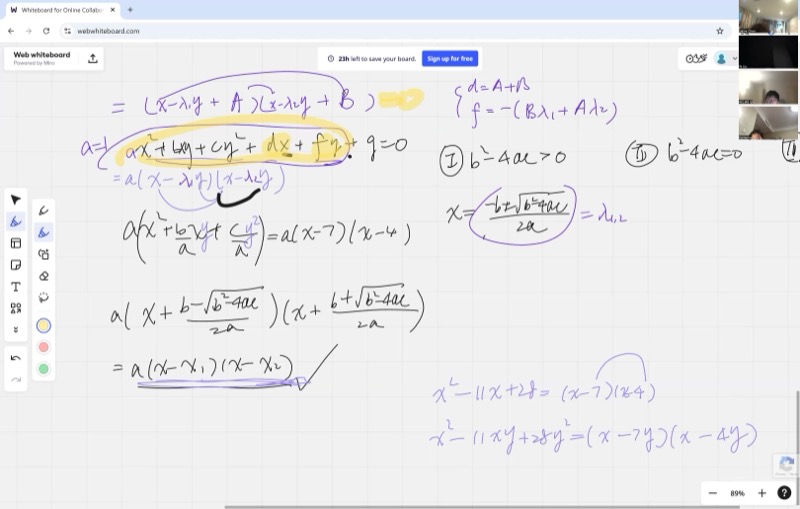
The linear terms can be absorbed. To accommodate \(dx + fy\), we solve: \[A + B = d, \quad -B\lambda_1 + A\lambda_2 = f\] This \(2 \times 2\) system has a unique solution precisely because \(\lambda_1 \neq \lambda_2\) (the lines are not parallel, so they intersect).
Asymptotic behavior exists. Setting \((x - \lambda_1 y + A)(x - \lambda_2 y + B) = h\) (some constant), one factor can approach zero while the other grows without bound. This is only possible because the two lines \(x - \lambda_1 y + A = 0\) and \(x - \lambda_2 y + B = 0\) are not parallel (different slopes \(1/\lambda_1\) vs \(1/\lambda_2\)). These lines are the asymptotes.
Case 2: \(b^2 - 4ac = 0\) – Parabola
A double root \(\lambda_1 = \lambda_2 = \lambda\) means the form is a perfect square:
\[a(x - \lambda y)^2\]
We cannot absorb both linear terms into one factor, so we define new perpendicular coordinates and obtain a parabola in the rotated frame.
Case 3: \(b^2 - 4ac < 0\) – Ellipse
No real roots exist – the form cannot be factored over the reals. The curve is closed: an ellipse (or a circle as a special case).
Drag the sliders for \(a\), \(b\), \(c\) and watch the conic change type. The value \(D = b^2 - 4ac\) updates in real time – positive for hyperbolas, zero at the transition, negative for ellipses.
3. Absorbing Linear Terms: The Full Equation
Starting from the general conic (with \(a = 1\) after dividing through):
\[x^2 + bxy + cy^2 + dx + fy + g = 0\]
After factoring the quadratic part, we want to write:
\[(x - \lambda_1 y + A)(x - \lambda_2 y + B) = h\]
where \(h = AB - g\).
Expanding the left side and matching the linear coefficients:
\[\begin{cases} A + B = d \\ -B\lambda_1 + A\lambda_2 = f \end{cases}\]
This is a \(2 \times 2\) linear system in \(A\) and \(B\). It has a unique solution when the determinant is nonzero, which happens exactly when \(\lambda_1 \neq \lambda_2\).
When \(\lambda_1 = \lambda_2\) (parabola case), the system may have no solution – meaning we cannot write the equation as a product of two linear factors. Instead, we proceed with a coordinate rotation.
The two lines \(x - \lambda_1 y + A = 0\) and \(x - \lambda_2 y + B = 0\) are the asymptotes of the hyperbola. Their slopes are \(1/\lambda_1\) and \(1/\lambda_2\) respectively, and they are guaranteed to be non-parallel because \(\lambda_1 \neq \lambda_2\).
4. Coordinate Rotation for Parabolas
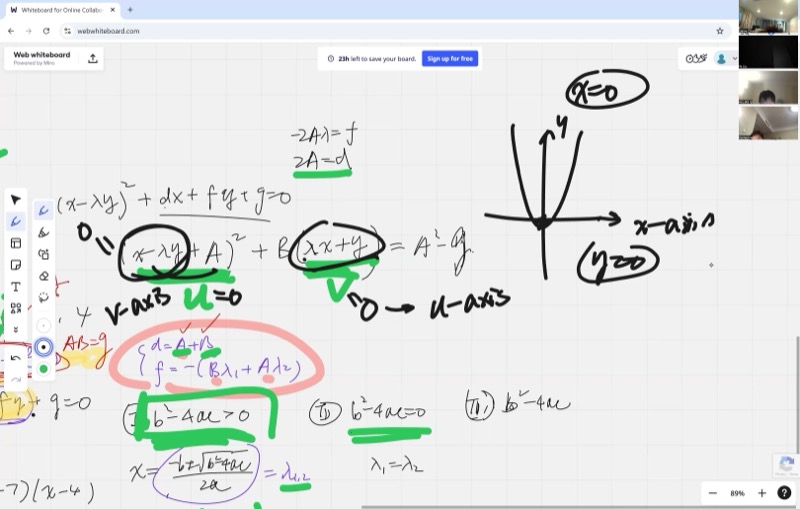
When \(b^2 - 4ac = 0\) (double root \(\lambda\)), the quadratic part becomes \((x - \lambda y)^2\) and we define new variables:
\[u = x - \lambda y, \qquad v = \lambda x + y\]
The lines \(u = 0\) and \(v = 0\) (i.e., \(x - \lambda y = 0\) and \(\lambda x + y = 0\)) are perpendicular to each other!
Proof: The slope of \(x - \lambda y = 0\) is \(\frac{1}{\lambda}\). The slope of \(\lambda x + y = 0\) is \(-\lambda\). Their product is: \[\frac{1}{\lambda} \times (-\lambda) = -1\] Slopes that multiply to \(-1\) are perpendicular. This ensures that \(u\) and \(v\) form a proper (rotated) coordinate system.
In the new coordinates, the equation becomes:
\[u^2 + (\text{linear in } u \text{ and } v) + (\text{constant}) = 0\]
After completing the square in \(u\), this takes the form:
\[(u - \alpha)^2 = \beta v + \gamma\]
which is a parabola in the rotated \((u, v)\)-plane!
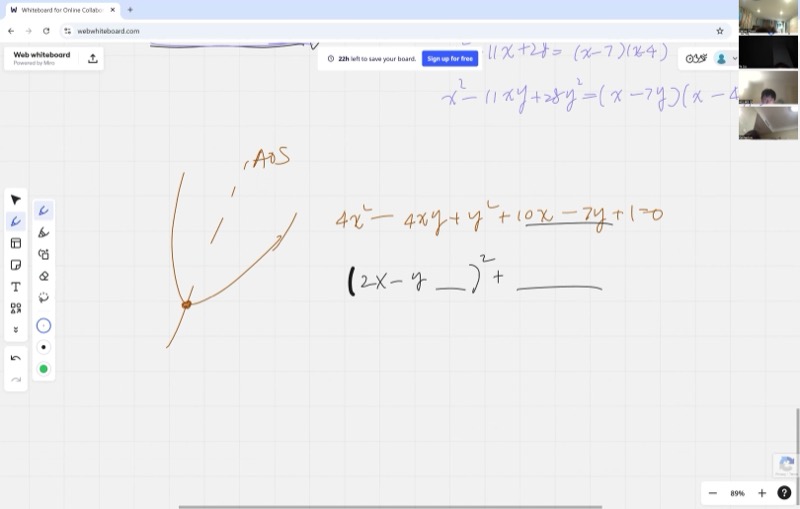
5. Worked Example: \(4x^2 - 4xy + y^2 + 10x - 7y + 1 = 0\)
The quadratic terms are \(4x^2 - 4xy + y^2\).
\[\Delta = b^2 - 4ac = (-4)^2 - 4(4)(1) = 16 - 16 = 0\]
Since \(\Delta = 0\), this is a parabola.
\[4x^2 - 4xy + y^2 = (2x - y)^2\]
So \(\lambda = \frac{1}{2}\) (the ratio in \(x - \lambda y = 0\) gives us \(2x - y\), meaning \(\lambda = 1/2\)).
We need \(v\) perpendicular to \(u = 2x - y\). The slope of \(2x - y = 0\) is \(2\), so we need slope \(-1/2\):
\[u = 2x - y, \qquad v = x + 2y\]
These are perpendicular because the slopes \(2\) and \(-\frac{1}{2}\) are negative reciprocals.
We write:
\[(2x - y + A)^2 + B(x + 2y) + C = 0\]
Expanding \((2x - y + A)^2 = 4x^2 - 4xy + y^2 + 4Ax - 2Ay + A^2\)
Matching the coefficient of \(x\): \(4A + B = 10\)
Matching the coefficient of \(y\): \(-2A + 2B = -7\)
Solving:
\[\begin{cases} 4A + B = 10 \\ -2A + 2B = -7 \end{cases}\]
From the second equation: \(B = \frac{2A - 7}{2}\)
Substituting: \(4A + \frac{2A - 7}{2} = 10 \Rightarrow 8A + 2A - 7 = 20 \Rightarrow 10A = 27 \Rightarrow A = \frac{27}{10}\)
Then \(B = \frac{27/5 - 7}{2} = \frac{-8/5}{2} = -\frac{4}{5}\)
The constant: \(C = 1 - A^2 = 1 - \frac{729}{100} = -\frac{629}{100}\)
So the equation becomes:
\[(2x - y + \tfrac{27}{10})^2 = \tfrac{4}{5}(x + 2y) + \tfrac{629}{100}\]
This is a parabola in the \((u, v)\) coordinates with:
- Axis of symmetry along the direction of \(v\): the line \(x + 2y = \text{const}\)
- Opens in the direction determined by the coefficient of \(v\)
The parabola \(4x^2 - 4xy + y^2 + 10x - 7y + 1 = 0\) shown in blue. The dashed red line is the axis of symmetry. The dotted orange and green lines show the \(u\)- and \(v\)-directions of the rotated coordinate system – notice they are perpendicular.
6. Summary: The Classification Algorithm
Given \(ax^2 + bxy + cy^2 + dx + fy + g = 0\):
Compute \(\Delta = b^2 - 4ac\)
If \(\Delta > 0\) (Hyperbola):
- Find \(\lambda_1, \lambda_2\) from the quadratic formula
- Factor: \(a(x - \lambda_1 y)(x - \lambda_2 y)\)
- Solve the \(2 \times 2\) system for \(A, B\) to absorb linear terms
- Result: \((x - \lambda_1 y + A)(x - \lambda_2 y + B) = h\)
- Asymptotes: \(x - \lambda_1 y + A = 0\) and \(x - \lambda_2 y + B = 0\)
If \(\Delta = 0\) (Parabola):
- Factor: \(a(x - \lambda y)^2\) (perfect square)
- Define perpendicular coordinates: \(u = x - \lambda y\), \(v = \lambda x + y\)
- Find constant \(A\) so that \(u + A\) absorbs as much of the linear part as possible
- Complete the square to get \((u + A)^2 = \beta v + \gamma\) (standard parabola form)
If \(\Delta < 0\) (Ellipse):
- Cannot factor over the reals
- Complete the square in both variables (rotation of axes via eigenvalues of the coefficient matrix)
Cheat Sheet
| Discriminant \(b^2 - 4ac\) | Conic Type | Eigenvalues | Factorization |
|---|---|---|---|
| \(> 0\) | Hyperbola | Two distinct real \(\lambda_1 \neq \lambda_2\) | \(a(x - \lambda_1 y)(x - \lambda_2 y)\) |
| \(= 0\) | Parabola | One repeated \(\lambda\) | \(a(x - \lambda y)^2\) |
| \(< 0\) | Ellipse | No real eigenvalues | Cannot factor over \(\mathbb{R}\) |
Quick Classification
\[\boxed{b^2 - 4ac \begin{cases} > 0 & \text{Hyperbola} \\ = 0 & \text{Parabola} \\ < 0 & \text{Ellipse} \end{cases}}\]
Eigenvalue Formula
\[\lambda_{1,2} = \frac{-b \pm \sqrt{b^2 - 4ac}}{2a}\]
Perpendicular Rotation (Parabola Case)
\[u = x - \lambda y, \qquad v = \lambda x + y \qquad (\text{slopes are negative reciprocals})\]
Absorbing Linear Terms (Hyperbola Case)
Solve \(\begin{cases} A + B = d \\ -B\lambda_1 + A\lambda_2 = f \end{cases}\) for \(A, B\). Asymptotes: \(x - \lambda_i y + (\text{const}) = 0\).