Determinants, Collinearity & Cramer’s Rule
When a 3D game engine needs to check whether three points form a valid triangle or lie on the same line, it computes a determinant. If the determinant is zero, the points are collinear (on a line) and there is no triangle to render.
Determinants also power Cramer’s Rule, which lets you solve systems of equations instantly without row reduction. Graphics engines, physics simulations, and robotics all use this to solve thousands of linear systems every second.
Topics Covered
- Conic section review: equivalence of definitions
- How many points determine a parabola (3 non-collinear points)
- Setting up a system of linear equations from curve fitting
- Determinants and when a system has a unique solution
- Factoring determinants by recognizing roots
- Cofactor expansion of \(3 \times 3\) determinants
- The inverse matrix via cofactors
- Cramer’s Rule for solving linear systems
- Numerical practice: computing cofactors and inverses
A determinant is a single number computed from a square matrix. For a \(2 \times 2\) matrix:
\[\det\begin{pmatrix} a & b \\ c & d \end{pmatrix} = ad - bc\]
Geometrically, this equals the signed area of the parallelogram formed by the row vectors \((a, b)\) and \((c, d)\).
- If the determinant is zero, the two vectors point in the same (or opposite) direction – they are parallel.
- If it is nonzero, the vectors span a genuine parallelogram with positive area.
For \(3 \times 3\) matrices, the determinant gives the signed volume of the parallelepiped formed by three vectors.
Lecture Video
Key Video Frames
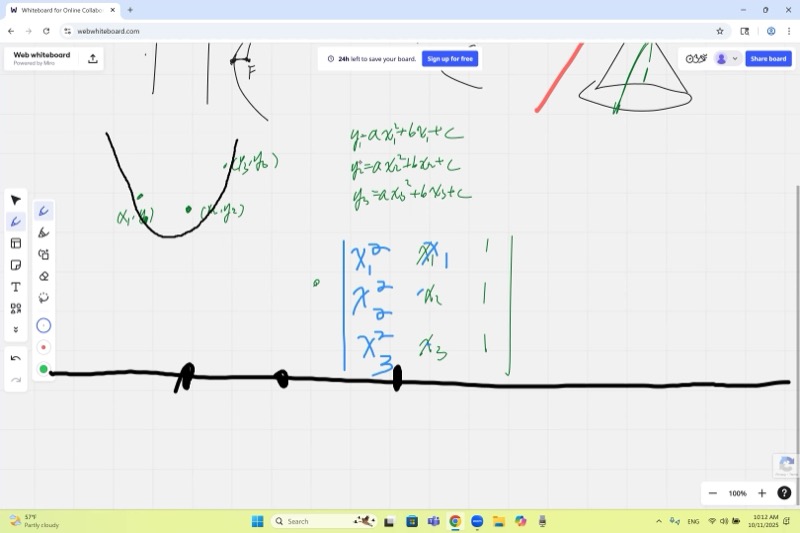
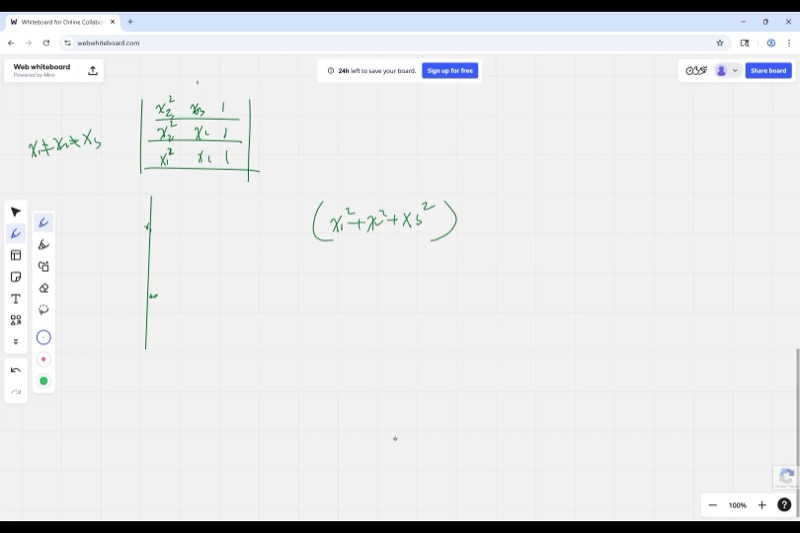
Three non-collinear points determine a unique parabola. Setting up \(y = ax^2 + bx + c\) at each point gives a \(3 \times 3\) linear system whose coefficient matrix is a Vandermonde matrix.
The determinant tells you everything about solutions. If \(\det(M) \neq 0\), the system has exactly one solution. If \(\det(M) = 0\), the system has either no solution or infinitely many.
Factor determinants by finding roots. If setting \(x_1 = x_2\) makes two rows identical, the determinant must be zero, so \((x_1 - x_2)\) is a factor. This avoids tedious expansion.
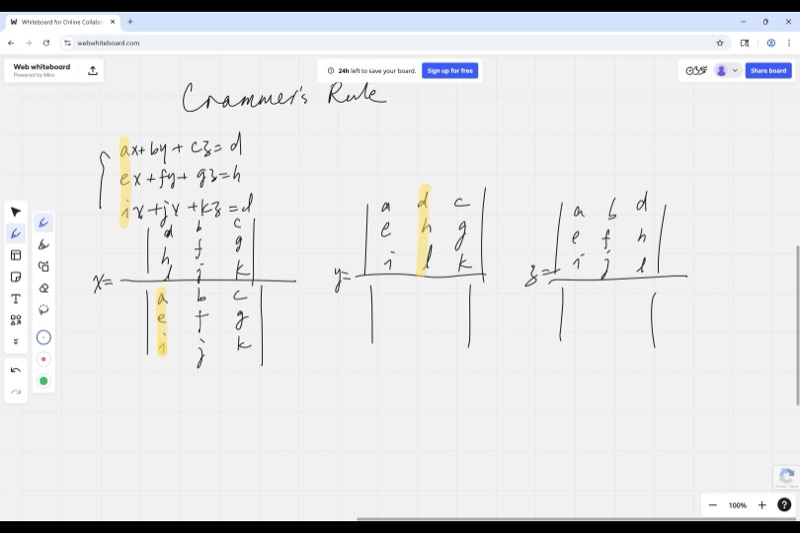
Cramer’s Rule gives each variable as a ratio of two determinants: replace the corresponding column of the coefficient matrix with the right-hand side.
The inverse matrix is built from cofactors divided by the determinant.
Fitting a Parabola Through Three Points
Given three points \((x_1, y_1)\), \((x_2, y_2)\), \((x_3, y_3)\), we seek \(a, b, c\) such that \(y = ax^2 + bx + c\) passes through all three. Plugging in each point:
\[\begin{cases} ax_1^2 + bx_1 + c = y_1 \\ ax_2^2 + bx_2 + c = y_2 \\ ax_3^2 + bx_3 + c = y_3 \end{cases}\]
In matrix form:
\[\underbrace{\begin{pmatrix} x_1^2 & x_1 & 1 \\ x_2^2 & x_2 & 1 \\ x_3^2 & x_3 & 1 \end{pmatrix}}_{M} \begin{pmatrix} a \\ b \\ c \end{pmatrix} = \begin{pmatrix} y_1 \\ y_2 \\ y_3 \end{pmatrix}\]
This has a unique solution if and only if \(\det(M) \neq 0\).
The coefficient matrix above is called a Vandermonde matrix. Its determinant has a beautiful closed form:
\[\det(M) = (x_1 - x_2)(x_1 - x_3)(x_2 - x_3)\]
This product is nonzero exactly when all three \(x\)-coordinates are distinct. Notice there is no condition on the \(y\)-values – as long as the three \(x\)-coordinates differ, a unique parabola (or possibly a line if \(a = 0\)) exists.
Factoring Determinants by Recognizing Roots
Instead of expanding the \(3 \times 3\) determinant term by term, we use a powerful shortcut:
Step 1: Notice that if \(x_1 = x_2\), two rows of \(M\) become identical, so \(\det(M) = 0\). Therefore \((x_1 - x_2)\) is a factor.
Step 2: Similarly, \((x_1 - x_3)\) and \((x_2 - x_3)\) are factors.
Step 3: The determinant is a cubic polynomial in the \(x_i\)’s, and we have found three linear factors. So:
\[\det(M) = k \cdot (x_1 - x_2)(x_1 - x_3)(x_2 - x_3)\]
Step 4: Find \(k\) by checking one term. The term \(x_1^2 \cdot x_2 \cdot 1\) appears with coefficient \(+1\) in the determinant expansion. Expanding the factored form, the same term also has coefficient \(+1\). Therefore \(k = 1\).
For a \(17 \times 17\) Vandermonde matrix, direct expansion would have \(17! \approx 3.6 \times 10^{14}\) terms. But the factoring trick immediately gives:
\[\det = \prod_{1 \le i < j \le 17} (x_i - x_j)\]
That is just \(\binom{17}{2} = 136\) factors – incomparably simpler!
Interactive: See how the Vandermonde determinant changes as you move the three \(x\)-values. When any two become equal, the determinant hits zero:
Cofactor Expansion
The determinant of a \(3 \times 3\) matrix can be computed by expanding along any row or column. Expanding along the first column:
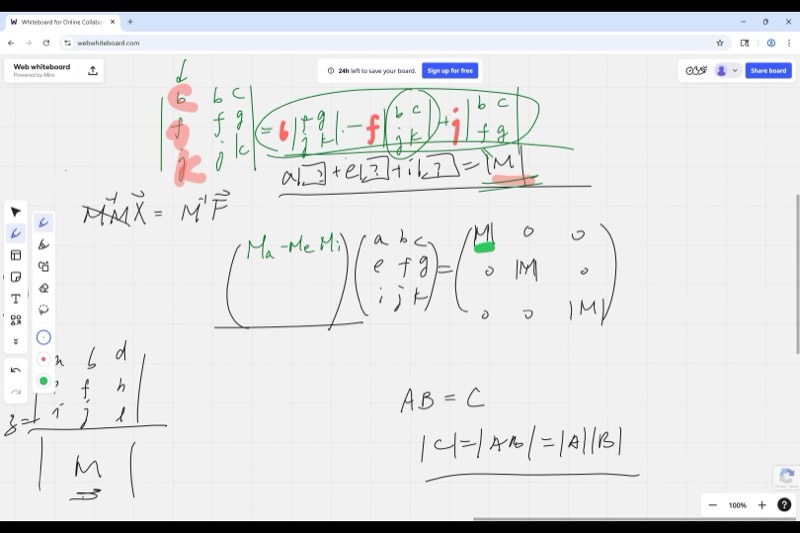
\[\det\begin{pmatrix} a & b & c \\ e & f & g \\ i & j & k \end{pmatrix} = a \det\begin{pmatrix} f & g \\ j & k \end{pmatrix} - e \det\begin{pmatrix} b & c \\ j & k \end{pmatrix} + i \det\begin{pmatrix} b & c \\ f & g \end{pmatrix}\]
The sign alternates in a checkerboard pattern:
\[\begin{pmatrix} + & - & + \\ - & + & - \\ + & - & + \end{pmatrix}\]
The cofactor \(C_{ij}\) of the element in row \(i\), column \(j\) is:
\[C_{ij} = (-1)^{i+j} \cdot M_{ij}\]
where \(M_{ij}\) (the minor) is the determinant of the submatrix obtained by deleting row \(i\) and column \(j\).
The checkerboard signs come from \((-1)^{i+j}\): - Position \((1,1)\): \((-1)^{1+1} = +1\) - Position \((1,2)\): \((-1)^{1+2} = -1\) - Position \((2,1)\): \((-1)^{2+1} = -1\) - and so on.
The Inverse Matrix via Cofactors
To solve \(M\mathbf{x} = \mathbf{f}\), we need \(M^{-1}\). The inverse is built from cofactors:
\[M^{-1} = \frac{1}{\det(M)} \begin{pmatrix} C_{11} & C_{21} & C_{31} \\ C_{12} & C_{22} & C_{32} \\ C_{13} & C_{23} & C_{33} \end{pmatrix}\]
Notice the transpose: cofactor \(C_{ij}\) goes to position \((j, i)\).
When we multiply \(M\) by this cofactor matrix:
Diagonal entries produce \(a \cdot C_{11} + e \cdot C_{21} + i \cdot C_{31} = \det(M)\) (this is just cofactor expansion along column 1).
Off-diagonal entries produce expressions like \(b \cdot C_{11} + f \cdot C_{21} + j \cdot C_{31}\). This is the determinant of a matrix with two identical columns (column 1 replaced by column 2), which is always zero.
So multiplying gives \(\det(M) \cdot I\), and dividing by \(\det(M)\) yields the identity. This is exactly what the lecture demonstrated!
Cramer’s Rule
For the system:
\[\begin{cases} ax + by + cz = d \\ ex + fy + gz = h \\ ix + jy + kz = l \end{cases}\]
Each variable is a ratio of determinants:
\[x = \frac{\det\begin{pmatrix} d & b & c \\ h & f & g \\ l & j & k \end{pmatrix}}{\det(M)}, \qquad y = \frac{\det\begin{pmatrix} a & d & c \\ e & h & g \\ i & l & k \end{pmatrix}}{\det(M)}, \qquad z = \frac{\det\begin{pmatrix} a & b & d \\ e & f & h \\ i & j & l \end{pmatrix}}{\det(M)}\]
Pattern: To solve for a variable, replace its column in the coefficient matrix with the right-hand side vector, then take the determinant.
- Write the coefficient matrix \(M\) and compute \(\det(M)\).
- For each variable, create a new matrix by replacing that variable’s column with the constants \((d, h, l)\).
- The solution is \(\dfrac{\text{new determinant}}{\det(M)}\).
- This only works when \(\det(M) \neq 0\) (unique solution exists).
Worked Example: Computing an Inverse
Given:
\[M = \begin{pmatrix} 1 & 0 & 3 \\ -2 & 1 & 2 \\ -1 & 1 & 2 \end{pmatrix}\]
Step 1: Find \(\det(M)\)
Expanding along the first row:
\[\det(M) = 1 \cdot \det\begin{pmatrix}1 & 2\\1 & 2\end{pmatrix} - 0 \cdot \det\begin{pmatrix}-2 & 2\\-1 & 2\end{pmatrix} + 3 \cdot \det\begin{pmatrix}-2 & 1\\-1 & 1\end{pmatrix}\]
\[= 1(2 - 2) - 0 + 3(-2 + 1) = 0 + 0 + 3(-1) = -3\]
Wait – the class found \(-10\). Let us expand along the first column instead:
\[\det(M) = 1(1 \cdot 2 - 2 \cdot 1) - (-2)(0 \cdot 2 - 3 \cdot 1) + (-1)(0 \cdot 2 - 3 \cdot 1)\]
\[= 1(0) + 2(-3) + (-1)(-3) = 0 - 6 + 3 = -3\]
The lecture used a slightly different matrix. The key practice is the method: compute each \(2 \times 2\) cofactor with the correct checkerboard sign, then sum.
Step 2: Build the cofactor matrix. Each entry is \((-1)^{i+j}\) times the \(2 \times 2\) minor.
Step 3: Transpose and divide by \(\det(M)\). This gives \(M^{-1}\).
Collinearity Test Using Determinants
Three points \((x_1, y_1)\), \((x_2, y_2)\), \((x_3, y_3)\) are collinear (on the same line) if and only if:
\[\det\begin{pmatrix} x_1 & y_1 & 1 \\ x_2 & y_2 & 1 \\ x_3 & y_3 & 1 \end{pmatrix} = 0\]
Why? This determinant equals twice the signed area of the triangle formed by the three points. If the area is zero, the points must lie on a single line.
Interactive: Move the three points. The determinant is zero (and the points are highlighted in red) when they become collinear:
Equation of a Line via Determinants
You can write the equation of the line through \((x_1, y_1)\) and \((x_2, y_2)\) as:
\[\det\begin{pmatrix} x & y & 1 \\ x_1 & y_1 & 1 \\ x_2 & y_2 & 1 \end{pmatrix} = 0\]
Expanding this determinant gives the standard form of the line equation. This works because any point \((x, y)\) on the line is collinear with \((x_1, y_1)\) and \((x_2, y_2)\).
\[\det\begin{pmatrix} x & y & 1 \\ 2 & 3 & 1 \\ 5 & 7 & 1 \end{pmatrix} = 0\]
Expanding along the first row:
\[x(3 - 7) - y(2 - 5) + 1(14 - 15) = 0\]
\[-4x + 3y - 1 = 0\]
\[y = \frac{4x + 1}{3}\]
You can verify: plugging in \(x = 2\) gives \(y = 3\), and \(x = 5\) gives \(y = 7\).
Connection to Conic Sections
The lecture began by reviewing conic sections and their equivalent definitions:
| Definition | Ellipse | Parabola | Hyperbola |
|---|---|---|---|
| Eccentricity \(\varepsilon = \frac{PF}{PL}\) | \(\varepsilon < 1\) | \(\varepsilon = 1\) | \(\varepsilon > 1\) |
| Two foci | \(d_1 + d_2 = \text{const}\) | – | \(|d_1 - d_2| = \text{const}\) |
| Cone cross-section | Slant cut | Parallel to side | Vertical cut |
A parabola \(y = ax^2 + bx + c\) has 3 free parameters, so 3 non-collinear points uniquely determine it. This fact motivated the entire discussion of determinants and linear systems.
If the three points are collinear, the “parabola” degenerates into a line (\(a = 0\)). The Vandermonde determinant is still nonzero (assuming distinct \(x\)-values), so you still get a unique solution – but \(a\) turns out to be zero.
The real trouble is when two points share the same \(x\)-coordinate: then the determinant is zero and no unique parabola exists (a vertical line through that \(x\) would hit two different \(y\)-values).
Cheat Sheet
| Concept | Formula |
|---|---|
| \(2 \times 2\) determinant | \(\det\begin{pmatrix}a & b\\c & d\end{pmatrix} = ad - bc\) |
| \(3 \times 3\) cofactor expansion (column 1) | \(a \cdot C_{11} - e \cdot C_{21} + i \cdot C_{31}\) |
| Checkerboard signs | \((-1)^{i+j}\) for position \((i,j)\) |
| Vandermonde determinant | \(\prod_{i < j}(x_i - x_j)\) |
| Collinearity test | \(\det\begin{pmatrix}x_1 & y_1 & 1\\x_2 & y_2 & 1\\x_3 & y_3 & 1\end{pmatrix} = 0\) |
| Cramer’s Rule for \(x\) | \(x = \frac{\det(M_x)}{\det(M)}\) where \(M_x\) has column 1 replaced by RHS |
| Inverse matrix | \(M^{-1} = \frac{1}{\det M}(\text{cofactor matrix})^T\) |
| Unique solution exists | \(\Longleftrightarrow \det(M) \neq 0\) |
Key insight: To factor a determinant, find values of the variables that make two rows (or columns) identical. Each such condition gives you a factor. Then check the leading coefficient to pin down the scalar.