Conic Sections: Ellipses, Hyperbolas & Focal Properties
Lecture Video
Key Video Frames
Background
Conic sections are the family of curves you get by slicing a cone at different angles: circles, ellipses, parabolas, and hyperbolas. We have previously studied circles (\(x^2 + y^2 = r^2\)) and parabolas (\(y = ax^2\)). This lesson explores the next two members of that family — the ellipse and the hyperbola — and reveals how they are connected through their focal point properties. An ellipse may be viewed as a stretched circle, and a hyperbola as its “inside-out” counterpart. Both curves are defined by distance conditions involving two special points called foci.
- An ellipse is the set of all points where the sum of distances to two foci is constant: \(d_1 + d_2 = 2a\).
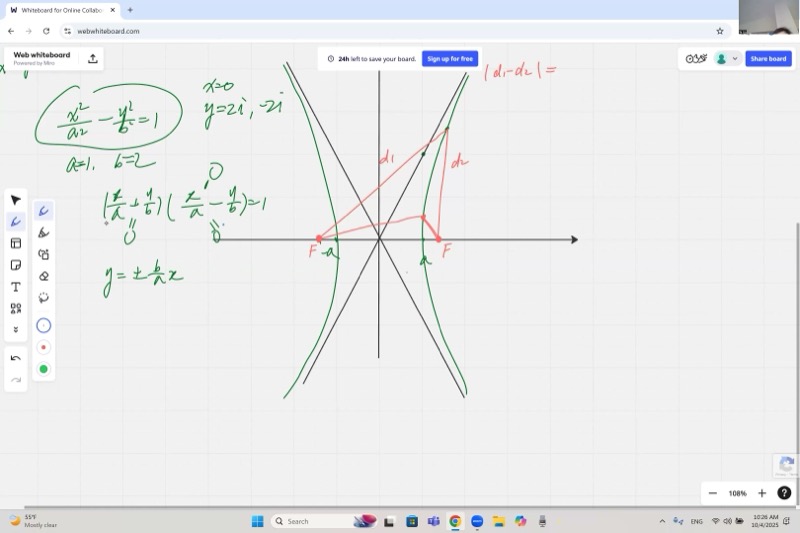
- A hyperbola is the set of all points where the difference of distances to two foci is constant: \(|d_1 - d_2| = 2a\).
- For the ellipse \(\dfrac{x^2}{a^2} + \dfrac{y^2}{b^2} = 1\), the focal distance satisfies \(a^2 = b^2 + c^2\).
- For the hyperbola \(\dfrac{x^2}{a^2} - \dfrac{y^2}{b^2} = 1\), the focal distance satisfies \(c^2 = a^2 + b^2\).
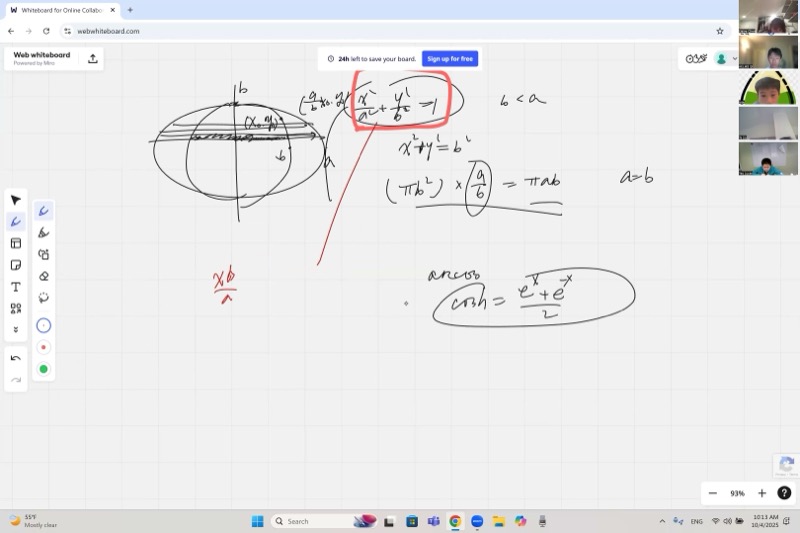
- The ellipse is a dilated circle — stretch a circle of radius \(b\) horizontally by the factor \(a/b\) and you get the ellipse. This gives the area formula \(A = \pi a b\).
- The hyperbola has asymptotes \(y = \pm \dfrac{b}{a}\,x\), found by factoring \(\dfrac{x^2}{a^2} - \dfrac{y^2}{b^2} = \left(\dfrac{x}{a} + \dfrac{y}{b}\right)\!\left(\dfrac{x}{a} - \dfrac{y}{b}\right) = 1\).
- The parabola is the limiting case between ellipse and hyperbola, defined by equal distance to a point and a line.
1. The Ellipse as a Stretched Circle
An ellipse with equation
\[\frac{x^2}{a^2} + \frac{y^2}{b^2} = 1\]
can be obtained by starting with a circle of radius \(b\),
\[x^2 + y^2 = b^2,\]
and stretching every point horizontally by the factor \(\dfrac{a}{b}\). Each point \((x_0, y_0)\) on the circle maps to \(\left(\dfrac{a}{b}\,x_0,\; y_0\right)\) on the ellipse.
Start with a point \((x_0, y_0)\) on the circle \(x^2 + y^2 = b^2\), so \(x_0^2 + y_0^2 = b^2\).
After stretching, the new point is \((X, Y) = \left(\frac{a}{b}\,x_0,\; y_0\right)\), which means \(x_0 = \frac{b}{a}\,X\) and \(y_0 = Y\).
Substituting back:
\[\left(\frac{b}{a}\,X\right)^2 + Y^2 = b^2 \;\;\Longrightarrow\;\; \frac{X^2}{a^2} + \frac{Y^2}{b^2} = 1\]
That is exactly the ellipse equation.
Area of the Ellipse
Since the ellipse is a circle of radius \(b\) (area \(\pi b^2\)) dilated horizontally by \(\dfrac{a}{b}\), every infinitesimally thin vertical strip is widened by that factor. Therefore,
\[A_{\text{ellipse}} = \pi b^2 \cdot \frac{a}{b} = \pi a b\]
When \(a = b = r\), this returns the familiar \(\pi r^2\).
2. Focal Points of the Ellipse
The two focal points \(F_1(-c, 0)\) and \(F_2(c, 0)\) satisfy \(a^2 = b^2 + c^2\).
Consider the point \(P = (0, b)\) at the top of the ellipse. By symmetry, the distances to both foci are equal:
\[d_1 = d_2 = \sqrt{c^2 + b^2}\]
Since \(d_1 + d_2 = 2a\), we get:
\[2\sqrt{c^2 + b^2} = 2a \;\;\Longrightarrow\;\; c^2 + b^2 = a^2\]
This is a clean geometric proof that the focal distance \(c = \sqrt{a^2 - b^2}\) for an ellipse.
3. The Hyperbola: Equation and Graph
The hyperbola
\[\frac{x^2}{a^2} - \frac{y^2}{b^2} = 1\]
is defined by the condition that the difference of distances to the two foci is constant:
\[|d_1 - d_2| = 2a\]
Finding Intercepts
- \(x\)-intercepts: Set \(y = 0\) to get \(x = \pm a\).
- \(y\)-intercepts: Set \(x = 0\) to get \(y^2 = -b^2\), so \(y = \pm bi\) — purely imaginary. There are no real \(y\)-intercepts.
Here \(a = 1\), \(b = 2\).
- \(x\)-intercepts at \((\pm 1, 0)\).
- No \(y\)-intercepts (they would be at \(\pm 2i\)).
- Asymptotes: \(y = \pm 2x\).
- The curve approaches but never touches the asymptotes.
- Focal points at \((\pm\sqrt{5}, 0)\) since \(c^2 = 1 + 4 = 5\).
Asymptotes by Factoring
Factor the left-hand side:
\[\frac{x^2}{a^2} - \frac{y^2}{b^2} = \left(\frac{x}{a} + \frac{y}{b}\right)\!\left(\frac{x}{a} - \frac{y}{b}\right) = 1\]
Neither factor can be zero (because their product is 1). Setting each factor to zero gives the untouchable lines — the asymptotes:
\[y = +\frac{b}{a}\,x \qquad\text{and}\qquad y = -\frac{b}{a}\,x\]
4. Proving \(c^2 = a^2 + b^2\) for the Hyperbola
The lecture proves this relationship three different ways.
Method 1: Using the vertex point
Take the vertex point \((a, 0)\). The distances to the foci are:
\[d_1 = c + a, \qquad d_2 = c - a\]
Their difference is:
\[d_1 - d_2 = (c + a) - (c - a) = 2a \;\checkmark\]
This confirms the constant difference but does not yet determine \(c\) in terms of \(a\) and \(b\).
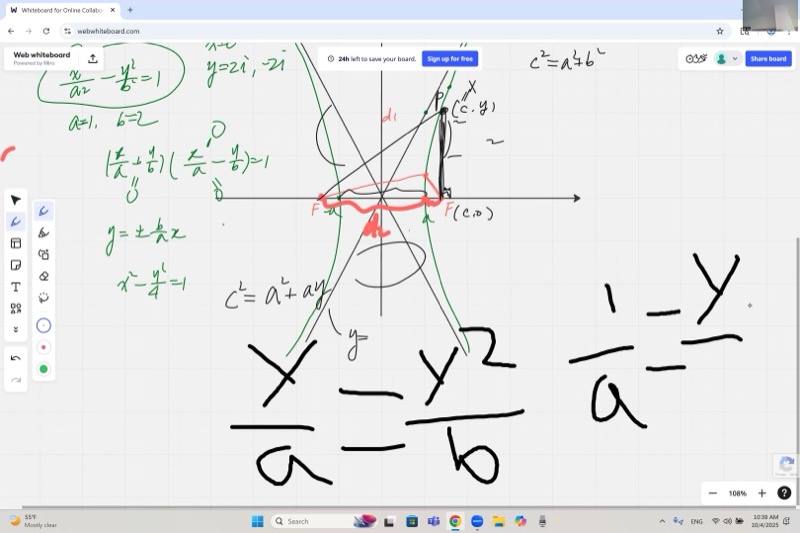
Method 2: Using the latus rectum
Let \(P = (c, y_P)\) be the point on the hyperbola directly above the focus \(F_2 = (c, 0)\). This vertical segment is called the latus rectum.
Step 1: Plug \(x = c\) into the hyperbola equation:
\[\frac{c^2}{a^2} - \frac{y_P^2}{b^2} = 1\]
Step 2: Compare with the relationship we want to prove. If \(c^2 = a^2 + b^2\), then \(\frac{c^2}{a^2} = 1 + \frac{b^2}{a^2}\), so:
\[\frac{y_P^2}{b^2} = \frac{c^2}{a^2} - 1 = \frac{b^2}{a^2} \;\;\Longrightarrow\;\; y_P = \frac{b^2}{a}\]
Step 3: The distances from \(P = (c, b^2/a)\) to the two foci are:
\[d_2 = \frac{b^2}{a}, \qquad d_1 = \sqrt{4c^2 + \frac{b^4}{a^2}}\]
Setting \(d_1 - d_2 = 2a\) and solving produces \(c^2 = a^2 + b^2\).
Method 3: Asymptotic argument at infinity
Take a point \(P\) on the hyperbola far from the origin, where the curve nearly coincides with the asymptote \(y = \frac{b}{a}x\).
At infinity, the lines \(PF_1\) and \(PF_2\) become essentially parallel to the asymptote. The difference \(d_1 - d_2\) reduces to the projection of the segment \(F_1 F_2\) (length \(2c\)) onto the asymptote direction.
The asymptote makes angle \(\theta\) with the \(x\)-axis where \(\tan\theta = \frac{b}{a}\).
Projecting: \(d_1 - d_2 = 2c \cos\theta\).
Since \(\cos\theta = \frac{a}{\sqrt{a^2+b^2}}\), the condition \(2c\cos\theta = 2a\) gives:
\[c \cdot \frac{a}{\sqrt{a^2+b^2}} = a \;\;\Longrightarrow\;\; c = \sqrt{a^2 + b^2}\]
This same construction produces a right triangle with legs \(2a\) and \(2b\) and hypotenuse \(2c\), confirming \(c^2 = a^2 + b^2\) geometrically.
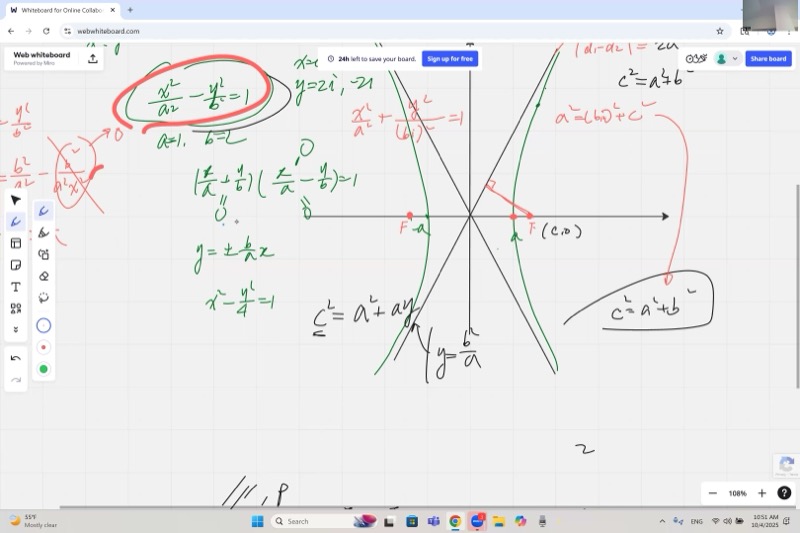
Method 4: Imaginary substitution (Toby’s insight)
Replace \(b\) with \(bi\) in the ellipse equation:
\[\frac{x^2}{a^2} + \frac{y^2}{(bi)^2} = 1 \;\;\Longrightarrow\;\; \frac{x^2}{a^2} - \frac{y^2}{b^2} = 1\]
This is exactly the hyperbola equation. For the ellipse, \(a^2 = b_{\text{ell}}^2 + c^2\). Substituting \(b_{\text{ell}} = bi\):
\[a^2 = (bi)^2 + c^2 = -b^2 + c^2 \;\;\Longrightarrow\;\; c^2 = a^2 + b^2\]
No geometry required — just algebraic substitution.
5. Distance from Focus to Asymptote
The triangle formed at infinity has sides \(2a\), \(2b\), and \(2c\). The small triangle formed by dropping a perpendicular from \(F_2 = (c, 0)\) to the asymptote is similar to this larger triangle (same angle \(\theta\)).
Since the large triangle has the ratio hypotenuse : opposite = \(2c : 2b\), the smaller triangle (with hypotenuse \(c\)) has opposite side:
\[d = \frac{b}{2c} \cdot 2c \cdot \frac{1}{2} = b\]
Wait — even simpler by similarity: the large triangle has sides \(2c\), \(2a\), \(2b\). The small triangle has hypotenuse \(c\) (half the large hypotenuse), so all sides are halved. The perpendicular distance from the focus to the asymptote is simply:
\[\boxed{d = b}\]
6. The Parabola: A Limiting Case
The parabola is the conic section that lives between the ellipse and the hyperbola.
- Ellipse: sum of distances to two foci = constant.
- Hyperbola: difference of distances to two foci = constant.
- Parabola: distance to one focus = distance to a line (the directrix).
The parabola may be understood as the case where one focus has moved to infinity while the other stays fixed, and the constant sum/difference also tends to infinity.
Cheat Sheet
| Conic | Equation | Distance Property | Focal Relation |
|---|---|---|---|
| Ellipse | \(\dfrac{x^2}{a^2} + \dfrac{y^2}{b^2} = 1\) | \(d_1 + d_2 = 2a\) | \(a^2 = b^2 + c^2\) |
| Hyperbola | \(\dfrac{x^2}{a^2} - \dfrac{y^2}{b^2} = 1\) | \(\lvert d_1 - d_2\rvert = 2a\) | \(c^2 = a^2 + b^2\) |
| Parabola | \(y^2 = 4px\) | \(d_{\text{focus}} = d_{\text{directrix}}\) | focus at \((p, 0)\) |
Quick Reference
| What you want | What to do |
|---|---|
| Area of ellipse | \(A = \pi a b\) |
| Foci of ellipse | \((\pm\sqrt{a^2 - b^2},\; 0)\) |
| Foci of hyperbola | \((\pm\sqrt{a^2 + b^2},\; 0)\) |
| Asymptotes of hyperbola | \(y = \pm\dfrac{b}{a}\,x\) |
| Latus rectum length | \(\dfrac{2b^2}{a}\) |
| Distance from focus to asymptote | \(b\) |
| Factor the hyperbola | \(\left(\dfrac{x}{a} + \dfrac{y}{b}\right)\!\left(\dfrac{x}{a} - \dfrac{y}{b}\right) = 1\) |