Conic Sections: Eccentricity, Directrix & the Parabola Derivation
The planets orbit the Sun in ellipses. Satellite dishes, flashlight reflectors, and radio telescopes are shaped like parabolas. Every GPS satellite relies on hyperbolic calculations. These three curves — ellipse, parabola, hyperbola — are the conic sections, and they are all unified by a single elegant idea: the ratio of a point’s distance to a focus versus its distance to a line. That ratio, called eccentricity, is the star of today’s lesson.
Topics Covered
- The focus-directrix definition of an ellipse (third definition)
- Proving the eccentricity ratio \(\varepsilon = c/a\) for every point on an ellipse
- Eccentricity for hyperbolas (\(\varepsilon > 1\)) and the directrix at \(x = a^2/c\)
- Deriving the parabola equation from \(\varepsilon = 1\) (equal distance condition)
- Why all parabolas are similar to each other
Lecture Video
Key Video Frames
Prerequisites
An ellipse centered at the origin with semi-major axis \(a\) (along \(x\)) and semi-minor axis \(b\) (along \(y\)) has the equation
\[\frac{x^2}{a^2} + \frac{y^2}{b^2} = 1\]
The foci are at \((\pm c, 0)\) where \(c^2 = a^2 - b^2\), and every point \(P\) on the ellipse satisfies
\[d_1 + d_2 = 2a\]
where \(d_1\) and \(d_2\) are the distances from \(P\) to the two foci. This is the “constant sum” definition. The ellipse can also be seen as a circle stretched (dilated) by the factor \(b/a\) in the \(y\)-direction.
A hyperbola centered at the origin has the equation
\[\frac{x^2}{a^2} - \frac{y^2}{b^2} = 1\]
The foci are at \((\pm c, 0)\) where \(c^2 = a^2 + b^2\) (note the plus sign — this is the key difference from ellipses). For any point \(P\) on the hyperbola, \(|d_1 - d_2| = 2a\).
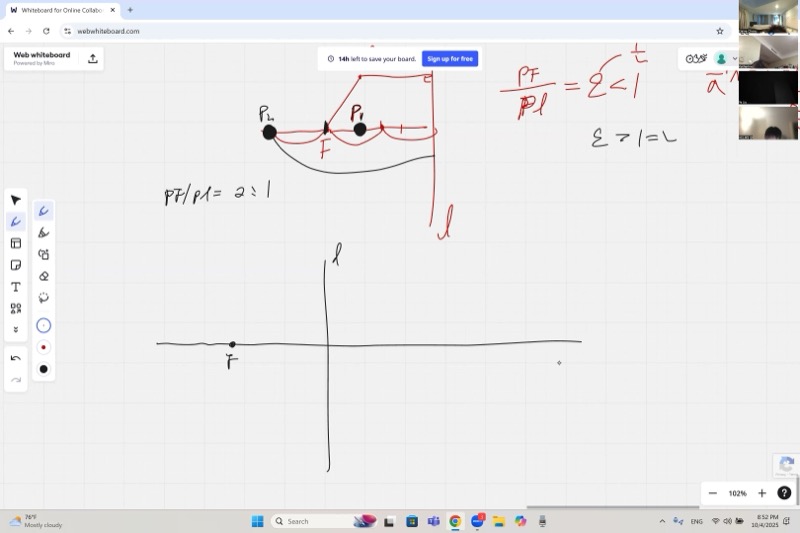
A directrix is a fixed straight line used together with a focus to define a conic section. For every point \(P\) on the conic, the ratio of the distance to the focus over the distance to the directrix is a constant called the eccentricity \(\varepsilon\).
Eccentricity \(\varepsilon = \dfrac{c}{a}\) classifies every conic section:
- \(\varepsilon < 1\) : ellipse
- \(\varepsilon = 1\) : parabola
- \(\varepsilon > 1\) : hyperbola
Directrix location: For an ellipse or hyperbola, the directrix is the vertical line \(x = \dfrac{a^2}{c}\).
Focus-directrix property: For any point \(P\) on the conic, \(\dfrac{PF}{PL} = \varepsilon\) (distance to focus over distance to directrix).
Parabola equation: Setting \(\varepsilon = 1\) with focus at \((0, c)\) and directrix \(y = -c\) yields \(x^2 = 4cy\).
All parabolas are similar — you can always rescale one to match another (unlike cubics or exponentials).
1. The Third Definition of an Ellipse
We already have two definitions of an ellipse:
- Definition 1 (constant sum): The set of points where \(d_1 + d_2 = 2a\).
- Definition 2 (stretched circle): A circle scaled by \(b/a\) in one direction.
Now we introduce a third, the focus-directrix definition.
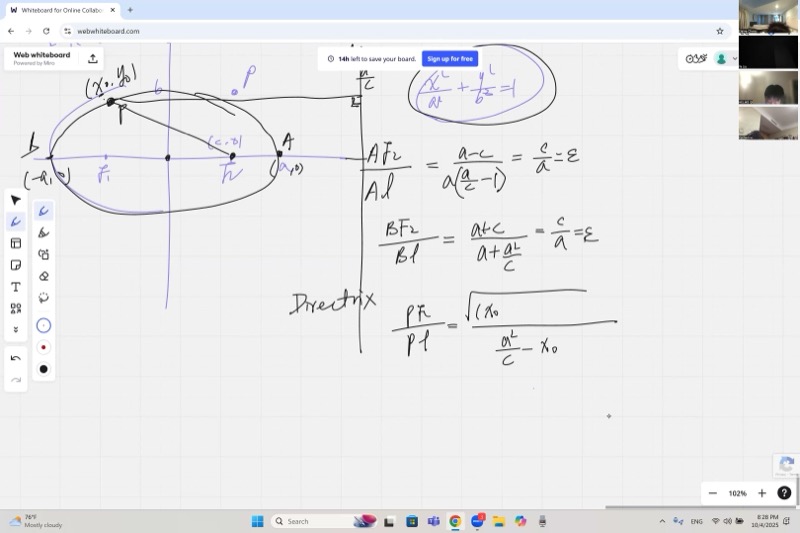
Given a focus \(F_2 = (c, 0)\) and a vertical line \(L\) (called the directrix) at \(x = \dfrac{a^2}{c}\), we claim that for every point \(P\) on the ellipse:
\[\frac{PF_2}{PL} = \frac{c}{a} = \varepsilon\]
Drag the \(\theta\) slider to move point \(P\) around the ellipse. Adjust \(a_0\) and \(b_0\) to reshape the ellipse and watch the directrix move.
Checking the Vertices
The right vertex is \(A = (a, 0)\).
Distance to focus: \(AF_2 = a - c\)
Distance to directrix: \(AL = \dfrac{a^2}{c} - a = \dfrac{a^2 - ac}{c} = \dfrac{a(a - c)}{c}\)
Ratio:
\[\frac{AF_2}{AL} = \frac{a - c}{\;\dfrac{a(a-c)}{c}\;} = \frac{c}{a} = \varepsilon \;\checkmark\]
The left vertex is \(B = (-a, 0)\).
Distance to focus: \(BF_2 = a + c\)
Distance to directrix: \(BL = \dfrac{a^2}{c} + a = \dfrac{a^2 + ac}{c} = \dfrac{a(a + c)}{c}\)
Ratio:
\[\frac{BF_2}{BL} = \frac{a + c}{\;\dfrac{a(a+c)}{c}\;} = \frac{c}{a} = \varepsilon \;\checkmark\]
2. Proof for an Arbitrary Point
Let \(P = (x_0, y_0)\) lie on the ellipse, so \(\dfrac{x_0^2}{a^2} + \dfrac{y_0^2}{b^2} = 1\).
Distance to the directrix (denominator):
\[PL = \frac{a^2}{c} - x_0\]
Distance to the focus (numerator):
\[PF_2 = \sqrt{(x_0 - c)^2 + y_0^2}\]
Step 1 — Eliminate \(y_0^2\): From the ellipse equation,
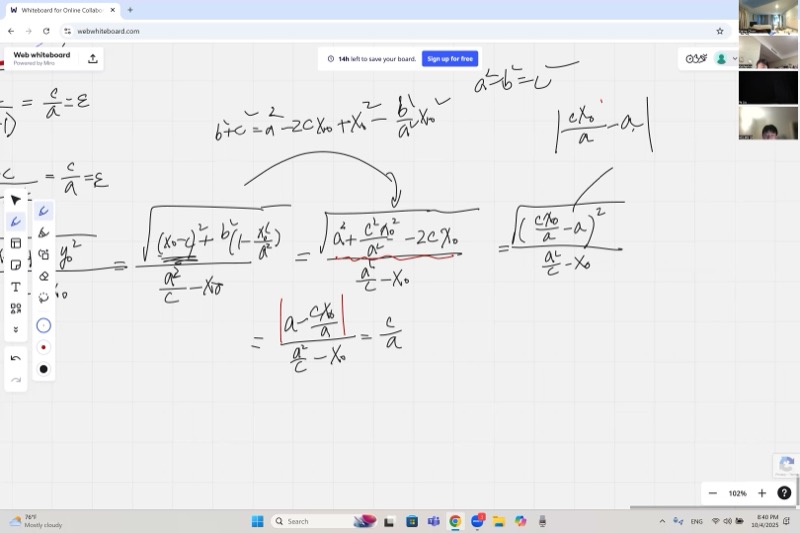
\[y_0^2 = b^2\!\left(1 - \frac{x_0^2}{a^2}\right) = \frac{b^2(a^2 - x_0^2)}{a^2}\]
Step 2 — Substitute into \(PF_2^2\):
\[PF_2^2 = (x_0 - c)^2 + \frac{b^2(a^2 - x_0^2)}{a^2}\]
Expand:
\[= x_0^2 - 2cx_0 + c^2 + b^2 - \frac{b^2 x_0^2}{a^2}\]
Since \(b^2 + c^2 = a^2\) and \(1 - \dfrac{b^2}{a^2} = \dfrac{c^2}{a^2}\):
\[= \frac{c^2 x_0^2}{a^2} - 2cx_0 + a^2 = \left(\frac{cx_0}{a} - a\right)^{\!2} = \left(a - \frac{cx_0}{a}\right)^{\!2}\]
Step 3 — Take the square root. Since \(-a \le x_0 \le a\), we have \(\dfrac{c\,x_0}{a} \le c < a\), so \(a - \dfrac{cx_0}{a} > 0\). Therefore:
\[PF_2 = a - \frac{cx_0}{a}\]
Step 4 — Form the ratio:
\[\frac{PF_2}{PL} = \frac{a - \dfrac{cx_0}{a}}{\dfrac{a^2}{c} - x_0} = \frac{\dfrac{a^2 - cx_0}{a}}{\dfrac{a^2 - cx_0}{c}} = \frac{c}{a} = \varepsilon \;\;\square\]
The common factor \(a^2 - cx_0\) cancels in numerator and denominator, leaving \(c/a\) — independent of which point \(P\) we chose. This proves the focus-directrix definition is equivalent to the original constant-sum definition.
3. Eccentricity Across the Conic Family
The eccentricity \(\varepsilon\) smoothly connects all three conic sections:
| Conic | Relationship | Eccentricity | Shape |
|---|---|---|---|
| Circle | \(c = 0\) | \(\varepsilon = 0\) | Perfectly round |
| Ellipse | \(c < a\), \(\;a^2 = b^2 + c^2\) | \(0 < \varepsilon < 1\) | Oval |
| Parabola | focus = directrix distance | \(\varepsilon = 1\) | Open U-shape |
| Hyperbola | \(c > a\), \(\;c^2 = a^2 + b^2\) | \(\varepsilon > 1\) | Two branches |
Drag the \(\varepsilon\) slider. Watch the conic section transform from an ellipse (\(\varepsilon < 1\)) through a parabola (\(\varepsilon = 1\)) to a hyperbola (\(\varepsilon > 1\)).
4. The Hyperbola: Directrix at \(x = a^2/c\)
For the hyperbola \(\dfrac{x^2}{a^2} - \dfrac{y^2}{b^2} = 1\) with \(c^2 = a^2 + b^2\):
- The foci are at \((\pm c, 0)\) with \(c > a\), so \(\varepsilon = c/a > 1\).
- The directrix is still at \(x = a^2/c\), which now falls inside the vertex (since \(a^2/c < a\)).
For an ellipse, \(c < a\), so \(a^2/c > a\) — the directrix is outside the ellipse, beyond the vertex.
For a hyperbola, \(c > a\), so \(a^2/c < a\) — the directrix is between the center and the vertex. The focus is far out, the directrix is pulled inward, and \(\varepsilon > 1\) means each point is farther from the focus than from the line.
Task: For any point \(P = (x_0, y_0)\) on the hyperbola \(\dfrac{x_0^2}{a^2} - \dfrac{y_0^2}{b^2} = 1\), show that
\[\frac{PF_2}{PL} = \frac{c}{a}\]
where \(F_2 = (c,0)\) and \(L\) is the line \(x = a^2/c\).
Hint: The algebra is very similar to the ellipse proof. Substitute \(y_0^2 = b^2\!\left(\dfrac{x_0^2}{a^2} - 1\right)\), expand \(PF_2^2\), and use \(c^2 = a^2 + b^2\). Watch the sign carefully when taking the square root — consider which branch \(P\) is on and the range of \(x_0\).
5. Deriving the Parabola from \(\varepsilon = 1\)
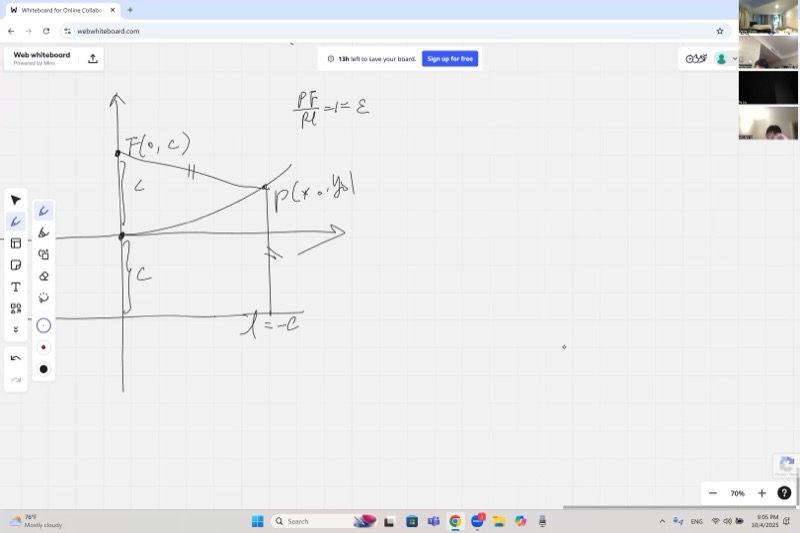
When \(\varepsilon = 1\), every point \(P\) is equidistant from the focus and the directrix. We place:
- Focus \(F\) at \((0, c)\)
- Directrix \(L\) at \(y = -c\)
- Origin at the midpoint (a natural vertex for the parabola)
Drag \(c_0\) to change the focal length — small \(c\) gives a narrow parabola, large \(c\) gives a wide one. Drag \(t_0\) to move point \(P\) and watch the two equal distances (red to focus, green to directrix).
Setup: \(F = (0, c)\), directrix \(y = -c\), and \(P = (x_0, y_0)\).
Condition: \(PF = PL\), i.e., the distance from \(P\) to the focus equals the distance from \(P\) to the directrix.
Distance to directrix:
\[PL = y_0 + c\]
(the vertical distance from \(P\) to the line \(y = -c\))
Distance to focus:
\[PF = \sqrt{x_0^2 + (y_0 - c)^2}\]
Set them equal and square both sides:
\[(y_0 + c)^2 = x_0^2 + (y_0 - c)^2\]
Expand both sides:
\[y_0^2 + 2cy_0 + c^2 = x_0^2 + y_0^2 - 2cy_0 + c^2\]
Cancel \(y_0^2\) and \(c^2\):
\[2cy_0 = x_0^2 - 2cy_0\]
\[4cy_0 = x_0^2\]
Result: Dropping the subscripts, the equation of the parabola is
\[\boxed{x^2 = 4cy}\]
This is the standard form of an upward-opening parabola with vertex at the origin. \(\square\)
Key observations
- The parameter \(c\) (focal length) controls how “wide” or “narrow” the parabola is.
- Small \(c\) \(\Rightarrow\) large coefficient \(\Rightarrow\) narrow parabola (focus and directrix close together).
- Large \(c\) \(\Rightarrow\) small coefficient \(\Rightarrow\) wide parabola (focus and directrix far apart).
- In the form \(y = kx^2\), we have \(k = \dfrac{1}{4c}\).
6. All Parabolas Are Similar
Every parabola is similar to every other parabola. You can always zoom in or out to make one parabola coincide with another. This is NOT true for cubics, exponentials, or most other curves.
Consider two parabolas: \(y = kx^2\) and \(y = \beta x^2\) where \(k \neq \beta\).
To show two parabolas are similar, we need to find a uniform scaling factor \(\lambda\) such that if \((x, y)\) is on one parabola, then \((\lambda x, \lambda y)\) is on the other.
If \((x, y)\) is on \(y = kx^2\), then \(y = kx^2\).
Scale by \(\lambda\): the new point is \((X, Y) = (\lambda x, \lambda y)\), so \(x = X/\lambda\) and \(y = Y/\lambda\).
Substituting: \(\dfrac{Y}{\lambda} = k \cdot \dfrac{X^2}{\lambda^2}\), which gives \(Y = \dfrac{k}{\lambda} X^2\).
We want this to equal \(Y = \beta X^2\), so we need \(\dfrac{k}{\lambda} = \beta\), i.e.,
\[\lambda = \frac{k}{\beta}\]
This always has a solution, so any two parabolas are similar. \(\square\)
Counterexample (homework): Try the same argument with \(y = kx^3\) and \(y = \beta x^3\). You will find that scaling \(x\) by \(\lambda\) scales \(y\) by \(\lambda^3\) (not \(\lambda\)), so a uniform scaling does not work — cubics with different coefficients are genuinely different curves.
Drag \(k\) and \(\beta\) to see two different parabolas. The dashed blue curve shows the first parabola after scaling by \(\lambda = k/\beta\) — it always coincides with the red one.
Homework
Hyperbola focus-directrix proof: For any point \(P = (x_0, y_0)\) on \(\dfrac{x^2}{a^2} - \dfrac{y^2}{b^2} = 1\), prove \(\dfrac{PF_2}{PL} = \dfrac{c}{a}\) where \(F_2 = (c,0)\) and \(L\!: x = a^2/c\). (Use algebra similar to the ellipse proof.)
Parabola similarity: Prove rigorously that \(y = kx^2\) and \(y = \beta x^2\) are always similar curves. Then show, as a counterexample, that \(y = kx^3\) and \(y = \beta x^3\) (with \(k \neq \beta\)) are not similar.
Cheat Sheet
| Concept | Formula / Fact |
|---|---|
| Ellipse equation | \(\dfrac{x^2}{a^2} + \dfrac{y^2}{b^2} = 1\), \(\;a^2 = b^2 + c^2\) |
| Hyperbola equation | \(\dfrac{x^2}{a^2} - \dfrac{y^2}{b^2} = 1\), \(\;c^2 = a^2 + b^2\) |
| Parabola equation | \(x^2 = 4cy\) (focus at \((0,c)\), directrix \(y = -c\)) |
| Eccentricity | \(\varepsilon = \dfrac{c}{a}\) |
| Directrix (ellipse/hyperbola) | \(x = \dfrac{a^2}{c}\) |
| Focus-directrix property | \(\dfrac{PF}{PL} = \varepsilon\) for all points \(P\) on the conic |
| Distance: point to focus (ellipse) | \(PF_2 = a - \dfrac{c\,x_0}{a}\) |
| Classifying conics | \(\varepsilon < 1\): ellipse, \(\;\varepsilon = 1\): parabola, \(\;\varepsilon > 1\): hyperbola |
| All parabolas are similar | Scale by \(\lambda = k/\beta\) to map \(y = kx^2\) onto \(y = \beta x^2\) |
Quick Reference: Completing the Square for PF
\[PF_2^2 = (x_0 - c)^2 + y_0^2 = \frac{c^2 x_0^2}{a^2} - 2cx_0 + a^2 = \left(a - \frac{cx_0}{a}\right)^{\!2}\]
Key substitution: \(y_0^2 = b^2\!\left(1 - \dfrac{x_0^2}{a^2}\right)\) and \(b^2 + c^2 = a^2\).