Complex Logarithms, Inverse Trig & Co-Terminal Angles
Recall that \(\cos\theta = \tfrac{1}{2}\) has infinitely many real solutions. But what happens when we attempt to solve \(\cos\theta = 2\)? No real angle has a cosine exceeding 1.
It turns out complex numbers save the day. By connecting Euler’s formula \(e^{i\theta} = \cos\theta + i\sin\theta\) with logarithms, we can solve “impossible” trig equations – and the answers are complex angles. This is the same math that powers signal processing, quantum mechanics, and electrical engineering.
Topics Covered
- Expressing \(\cos\theta\) and \(\sin\theta\) in terms of complex exponentials
- Solving \(\cos\theta = a\) and \(\sin\theta = a\) for \(a > 1\) (complex angles)
- Complex logarithms and \(\ln i\)
- Co-terminal angles and their importance when dividing angles
- Solving \(\cos(5\theta) = \tfrac{1}{2}\): finding all 10 solutions on the unit circle
Lecture Video
Key Video Frames
Prerequisites
Euler’s formula connects exponentials with trigonometry:
\[e^{i\theta} = \cos\theta + i\sin\theta\]
On the unit circle, the complex number \(e^{i\theta}\) is the point at angle \(\theta\) (in radians). Its real part is \(\cos\theta\) and its imaginary part is \(\sin\theta\).
The conjugate of \(e^{i\theta}\) is \(e^{-i\theta} = \cos\theta - i\sin\theta\).
A logarithm is the inverse of an exponential. If \(a^x = b\), then by definition:
\[x = \log_a b\]
The natural logarithm \(\ln\) uses base \(e \approx 2.718\):
\[e^x = b \quad\Longleftrightarrow\quad x = \ln b\]
Key identity: \(\ln(ab) = \ln a + \ln b\) (adding exponents = multiplying powers).
Two expressions like \(2 + \sqrt{3}\) and \(2 - \sqrt{3}\) are radical conjugates. Their product is always rational:
\[(2 + \sqrt{3})(2 - \sqrt{3}) = 4 - 3 = 1\]
So they are reciprocals of each other. This fact is crucial when we show that \(\ln(2+\sqrt{3}) + \ln(2-\sqrt{3}) = 0\).
Key Ideas
Exponential forms of cosine and sine:
\[\cos\theta = \frac{e^{i\theta} + e^{-i\theta}}{2}, \qquad \sin\theta = \frac{e^{i\theta} - e^{-i\theta}}{2i}\]
General solution for \(\cos\theta = a\):
\[e^{i\theta} = a \pm \sqrt{a^2 - 1}\]
\[\theta = -i\ln\!\bigl(a \pm \sqrt{a^2 - 1}\bigr) + 2k\pi, \quad k \in \mathbb{Z}\]
Complex logarithm of a complex number \(z = re^{i\phi}\):
\[\ln z = \ln r + i\phi + 2k\pi i, \quad k \in \mathbb{Z}\]
Co-terminal angles matter: When you divide both sides of \(5\theta = \pm\frac{\pi}{3} + 2k\pi\) by 5, the \(2k\pi\) term becomes \(\frac{2k\pi}{5}\), producing distinct solutions that are not hidden behind each other.
Warm-Up: Solving \(\cos\theta = \tfrac{1}{2}\) (Real Case)
On the unit circle, \(\cos\theta\) is the horizontal coordinate. To solve \(\cos\theta = \tfrac{1}{2}\), draw the vertical line \(x = \tfrac{1}{2}\) – it hits the circle at two points:
\[\theta = \pm\frac{\pi}{3} + 2k\pi, \quad k \in \mathbb{Z}\]
That is, \(60°\) and \(300°\), plus any full rotation.
Deriving the Exponential Form of Cosine
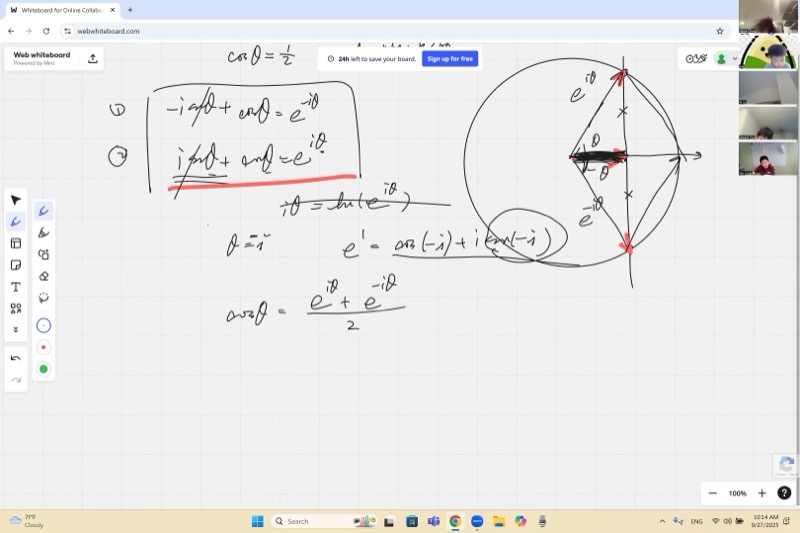
Starting from Euler’s formula and its conjugate:
\[e^{i\theta} = \cos\theta + i\sin\theta\] \[e^{-i\theta} = \cos\theta - i\sin\theta\]
Add them to cancel the sine terms:
\[e^{i\theta} + e^{-i\theta} = 2\cos\theta\]
The two vectors \(e^{i\theta}\) and \(e^{-i\theta}\) on the unit circle are reflections across the real axis. They share the same horizontal component (\(\cos\theta\)) but have opposite vertical components (\(+i\sin\theta\) and \(-i\sin\theta\)). Adding them doubles the real part and zeroes out the imaginary part.
\[\boxed{\cos\theta = \frac{e^{i\theta} + e^{-i\theta}}{2}}\]
Similarly, subtract them to isolate sine:
\[e^{i\theta} - e^{-i\theta} = 2i\sin\theta\]
\[\boxed{\sin\theta = \frac{e^{i\theta} - e^{-i\theta}}{2i}}\]
Solving \(\cos\theta = 2\) (Complex Angle)
Since no real angle has \(|\cos\theta| > 1\), the angle \(\theta\) must be complex. Substitute the exponential form:
\[\frac{e^{i\theta} + e^{-i\theta}}{2} = 2\]
Let \(u = e^{i\theta}\), so \(e^{-i\theta} = \frac{1}{u}\) (the exponential is never zero):
\[u + \frac{1}{u} = 4\]
Multiply through by \(u\):
\[u^2 - 4u + 1 = 0\]
Apply the quadratic formula:
\[u = \frac{4 \pm \sqrt{16 - 4}}{2} = \frac{4 \pm \sqrt{12}}{2} = 2 \pm \sqrt{3}\]
Both solutions are positive real numbers. Notice they are reciprocals:
\[(2+\sqrt{3})(2-\sqrt{3}) = 4 - 3 = 1\]
Now recover \(\theta\) from \(e^{i\theta} = u\):
\[i\theta = \ln u \quad\Longrightarrow\quad \theta = \frac{\ln u}{i} = -i\ln u\]
So:
\[\theta = -i\ln(2+\sqrt{3}) \quad\text{or}\quad \theta = -i\ln(2-\sqrt{3})\]
Since \(\ln(2-\sqrt{3}) = -\ln(2+\sqrt{3})\) (they are reciprocals), we can write:
\[\boxed{\theta = \pm i\ln(2+\sqrt{3}) + 2k\pi, \quad k \in \mathbb{Z}}\]
The answer is purely imaginary (plus the real co-terminal shifts \(2k\pi\)).
Since \((2+\sqrt{3})(2-\sqrt{3}) = 1\), we have \(2-\sqrt{3} = \frac{1}{2+\sqrt{3}}\).
If \(e^x = 2+\sqrt{3}\), then \(e^{-x} = \frac{1}{2+\sqrt{3}} = 2-\sqrt{3}\).
Taking \(\ln\): \(\ln(2-\sqrt{3}) = -x = -\ln(2+\sqrt{3})\).
Equivalently, using the product rule:
\[\ln(2+\sqrt{3}) + \ln(2-\sqrt{3}) = \ln\!\bigl[(2+\sqrt{3})(2-\sqrt{3})\bigr] = \ln 1 = 0 \;\;\checkmark\]
General Formula: \(\cos\theta = a\)
For any real number \(a\) (even \(|a| > 1\)):
\[e^{i\theta} = a \pm \sqrt{a^2 - 1}\]
\[\theta = -i\ln\!\bigl(a \pm \sqrt{a^2-1}\bigr) + 2k\pi\]
- When \(|a| \le 1\): \(a^2 - 1 \le 0\), so \(\sqrt{a^2-1}\) is imaginary, and \(\theta\) turns out purely real (the familiar real angles).
- When \(|a| > 1\): \(\sqrt{a^2-1}\) is real, and \(\theta\) is purely imaginary (plus co-terminal \(2k\pi\)).
Solving \(\sin\theta = 7\) (Complex Angle)
Use the exponential form of sine:
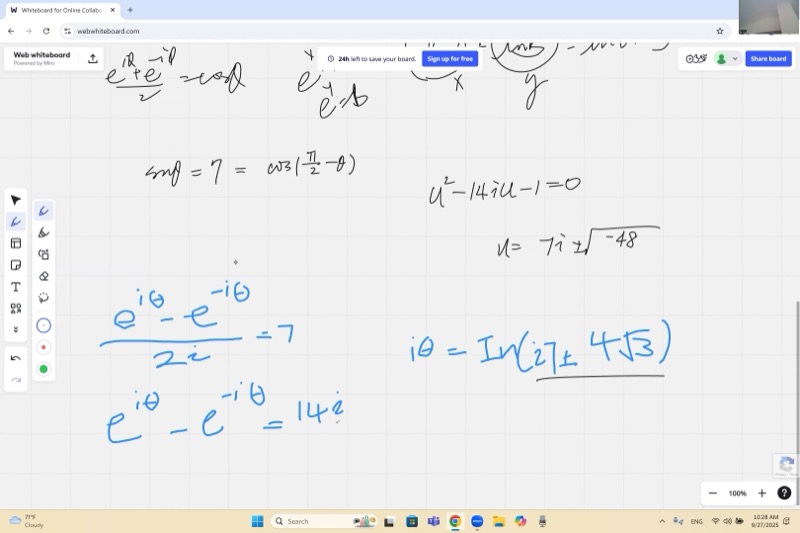
\[\frac{e^{i\theta} - e^{-i\theta}}{2i} = 7\]
Let \(u = e^{i\theta}\):
\[u - \frac{1}{u} = 14i\]
Multiply by \(u\):
\[u^2 - 14iu - 1 = 0\]
\[u = \frac{14i \pm \sqrt{-196 + 4}}{2} = \frac{14i \pm \sqrt{-192}}{2} = \frac{14i \pm 8i\sqrt{3}}{2} = i(7 \pm 4\sqrt{3})\]
So \(e^{i\theta} = i(7 \pm 4\sqrt{3})\).
To take \(\ln\), rewrite using magnitude and angle. Since \(i = e^{i\pi/2}\):
\[e^{i\theta} = (7 \pm 4\sqrt{3})\,e^{i\pi/2}\]
Take \(\ln\) of both sides:
\[i\theta = \ln(7 \pm 4\sqrt{3}) + \frac{\pi}{2}i + 2k\pi i\]
Divide by \(i\):
\[\theta = \frac{\pi}{2} + 2k\pi \;\pm\; i\ln(7 + 4\sqrt{3})\]
Unlike the cosine case, the answer has both a real and an imaginary part. The real part \(\frac{\pi}{2}\) comes from the angle of \(i\).
The Complex Logarithm: \(\ln i\) and \(\ln z\)
Every complex number \(z \ne 0\) can be written in polar form \(z = re^{i\phi}\).
\[\ln z = \ln r + i\phi\]
But because \(e^{i(\phi + 2k\pi)} = e^{i\phi}\) for any integer \(k\), the logarithm has infinitely many values:
\[\ln z = \ln r + i(\phi + 2k\pi), \quad k \in \mathbb{Z}\]
Since \(i = e^{i\pi/2}\), we have \(r = 1\) and \(\phi = \frac{\pi}{2}\):
\[\ln i = \frac{\pi}{2}i + 2k\pi i, \quad k \in \mathbb{Z}\]
The principal value (with \(k=0\)) is \(\frac{\pi}{2}i\).
Other values: \(\frac{5\pi}{2}i\), \(-\frac{3\pi}{2}i\), etc.
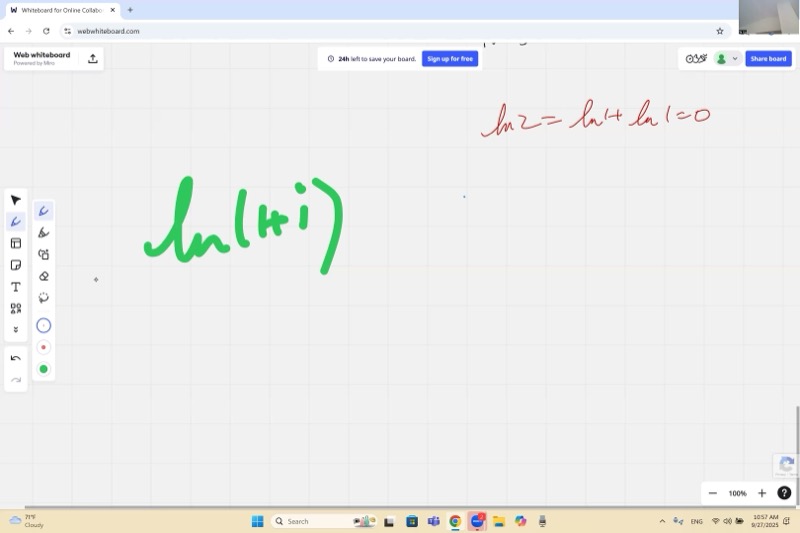
Write \(1+i\) in polar form. The magnitude is \(\sqrt{1^2+1^2} = \sqrt{2}\) and the angle is \(\frac{\pi}{4}\):
\[1+i = \sqrt{2}\,e^{i\pi/4}\]
Therefore:
\[\ln(1+i) = \ln\sqrt{2} + \frac{\pi}{4}i + 2k\pi i = \frac{1}{2}\ln 2 + \frac{\pi}{4}i + 2k\pi i\]
Key technique: Always decompose a complex number into its magnitude (a positive real number) and angle (a unit complex exponential) before taking \(\ln\). Then use \(\ln(r \cdot e^{i\phi}) = \ln r + i\phi\).
Co-Terminal Angles: Why They Matter
Solving \(\cos(5\theta) = \tfrac{1}{2}\)
From the warm-up, we know:
\[5\theta = \pm\frac{\pi}{3} + 2k\pi, \quad k \in \mathbb{Z}\]
Divide by 5:
\[\theta = \pm\frac{\pi}{15} + \frac{2k\pi}{5}\]
The period shrinks from \(2\pi\) to \(\frac{2\pi}{5} = 72°\). This means solutions that were “hidden behind each other” before now become distinct points on the unit circle.
From \(\theta = \frac{\pi}{15}\) (i.e., \(12°\)):
| \(k\) | \(\theta\) | degrees |
|---|---|---|
| 0 | \(12°\) | \(12°\) |
| 1 | \(12° + 72°\) | \(84°\) |
| 2 | \(12° + 144°\) | \(156°\) |
| 3 | \(12° + 216°\) | \(228°\) |
| 4 | \(12° + 288°\) | \(300°\) |
From \(\theta = -\frac{\pi}{15}\) (i.e., \(-12°\) or equivalently \(348°\)):
| \(k\) | \(\theta\) | degrees |
|---|---|---|
| 0 | \(-12°\) | \(348°\) |
| 1 | \(-12° + 72°\) | \(60°\) |
| 2 | \(-12° + 144°\) | \(132°\) |
| 3 | \(-12° + 216°\) | \(204°\) |
| 4 | \(-12° + 288°\) | \(276°\) |
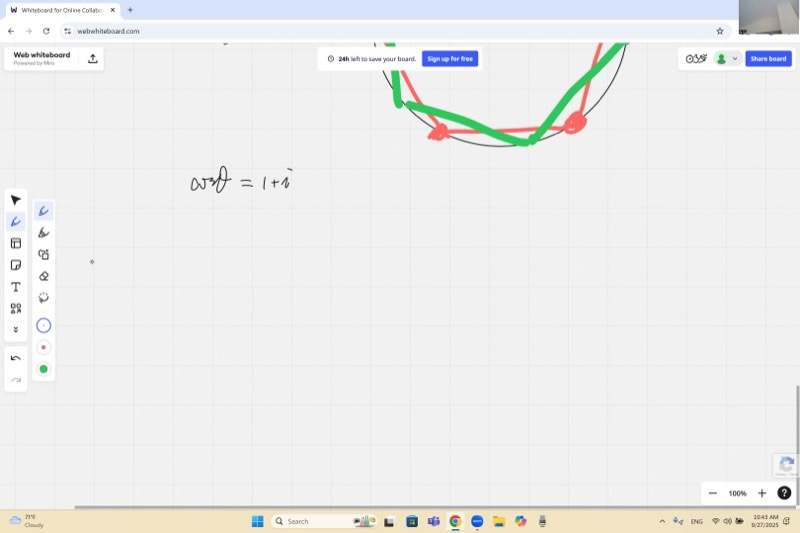
That gives 10 distinct solutions on the unit circle. Each set of 5 forms a regular pentagon!
The blue points and red points each form a regular pentagon – two pentagons rotated \(24°\) apart, giving 10 evenly-spaced-ish solutions.
Solving \(\cos\theta = 1+i\) (Complex Argument)
The general formula works even when \(a\) is complex:
\[e^{i\theta} = (1+i) \pm \sqrt{(1+i)^2 - 1}\]
First compute \((1+i)^2 - 1\):
\[(1+i)^2 = 1 + 2i + i^2 = 1 + 2i - 1 = 2i\]
\[\sqrt{(1+i)^2 - 1} = \sqrt{2i}\]
To find \(\sqrt{2i}\), write \(2i = 2e^{i\pi/2}\), so:
\[\sqrt{2i} = \sqrt{2}\,e^{i\pi/4} = \sqrt{2}\left(\frac{\sqrt{2}}{2} + i\frac{\sqrt{2}}{2}\right) = 1 + i\]
Therefore:
\[e^{i\theta} = (1+i) \pm (1+i) = \begin{cases} 2+2i \\ 0 \end{cases}\]
Since \(e^{i\theta} \ne 0\), we keep only \(e^{i\theta} = 2+2i\).
Write \(2+2i = 2\sqrt{2}\,e^{i\pi/4}\), then:
\[i\theta = \ln(2\sqrt{2}) + \frac{\pi}{4}i + 2k\pi i\]
\[\theta = \frac{\pi}{4} + 2k\pi - i\ln(2\sqrt{2})\]
Homework: Verify this and find the full set of solutions (there is a second branch from the other square root of \(2i\)).
Cheat Sheet
| Formula | Expression |
|---|---|
| Euler’s formula | \(e^{i\theta} = \cos\theta + i\sin\theta\) |
| Cosine (exponential) | \(\cos\theta = \dfrac{e^{i\theta}+e^{-i\theta}}{2}\) |
| Sine (exponential) | \(\sin\theta = \dfrac{e^{i\theta}-e^{-i\theta}}{2i}\) |
| Solve \(\cos\theta = a\) | \(e^{i\theta} = a \pm \sqrt{a^2-1}\), then \(\theta = -i\ln(\cdots)+2k\pi\) |
| Solve \(\sin\theta = a\) | \(e^{i\theta} = ia \pm \sqrt{1-a^2}\), then \(\theta = -i\ln(\cdots)+2k\pi\) |
| Complex logarithm | \(\ln(re^{i\phi}) = \ln r + i\phi + 2k\pi i\) |
| \(\ln i\) | \(\dfrac{\pi}{2}i + 2k\pi i\) |
| \(\ln\) of reciprocals | \(\ln\!\tfrac{1}{b} = -\ln b\) |
| Co-terminal angles | \(\theta\) and \(\theta + 2k\pi\) represent the same direction |
| Dividing co-terminals | \(n\theta = \alpha + 2k\pi \;\Rightarrow\; \theta = \frac{\alpha}{n} + \frac{2k\pi}{n}\) (produces \(n\) distinct solutions per base angle) |
Quick Reference: Taking \(\ln\) of a Complex Number
- Write \(z = r\,e^{i\phi}\) (magnitude \(r\) and angle \(\phi\)).
- \(\ln z = \ln r + i\phi + 2k\pi i\).
- The \(\ln r\) part handles the size; the \(i\phi\) part handles the angle.