Euler’s Formula: Why \(e^{i\theta} = \cos\theta + i\sin\theta\)
Euler’s formula is one of the most beautiful equations in all of mathematics. It connects three seemingly unrelated worlds:
- Exponential functions (growth and decay, compound interest)
- Trigonometric functions (circles, waves, rotations)
- Complex numbers (numbers with a “sideways” direction)
It is the key to understanding how rotating a complex number on the unit circle is the same as multiplying by an exponential. Engineers use it to analyze electrical circuits, physicists use it in quantum mechanics, and signal processing relies on it every time you stream music or video.
Topics Covered
- Additive functions and the functional equation \(f(x + y) = f(x) + f(y)\)
- Proving that continuous additive functions must be linear
- Multiplicative functions and the functional equation \(g(x + y) = g(x) \cdot g(y)\)
- Connecting multiplication to addition via logarithms
- The proof that \(e^{i\theta} = \cos\theta + i\sin\theta\)
- Continuity: the rigorous epsilon definition
Lecture Video
Key Video Frames
Prerequisites
A complex number \(z = a + bi\) has a real part \(a\) and an imaginary part \(b\), where \(i^2 = -1\).
On the unit circle (radius 1), every point can be written as:
\[z = \cos\theta + i\sin\theta\]
where \(\theta\) is the angle measured counterclockwise from the positive real axis. The real part is \(\cos\theta\) (horizontal coordinate) and the imaginary part is \(\sin\theta\) (vertical coordinate).
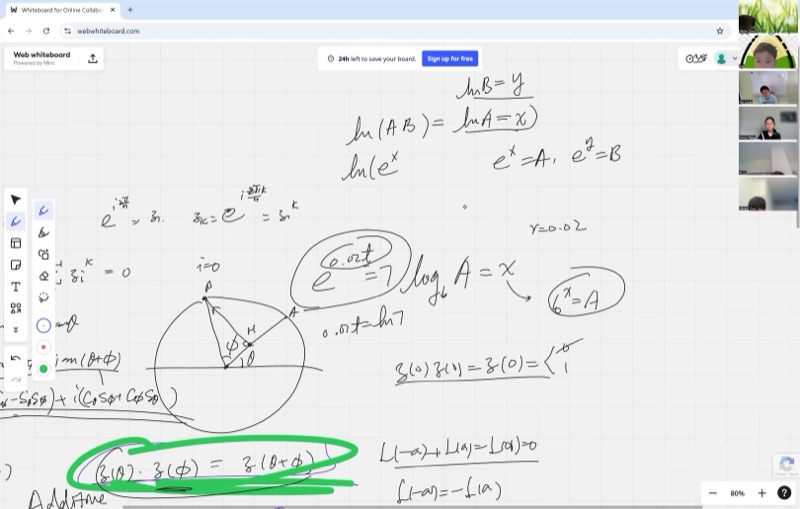
When you multiply two unit complex numbers with angles \(\theta\) and \(\phi\), you get a unit complex number with angle \(\theta + \phi\). Expanding the multiplication gives the angle-addition identities:
\[\cos(\theta + \phi) = \cos\theta\cos\phi - \sin\theta\sin\phi\]
\[\sin(\theta + \phi) = \cos\theta\sin\phi + \sin\theta\cos\phi\]
These can be proven geometrically by dropping an altitude on the unit circle and computing coordinates.
We previously proved (via compound interest / binomial expansion) that:
\[e^x = \sum_{n=0}^{\infty} \frac{x^n}{n!} = 1 + x + \frac{x^2}{2!} + \frac{x^3}{3!} + \cdots\]
A key property of the exponential is that \(e^{a+b} = e^a \cdot e^b\) – adding exponents corresponds to multiplying values.
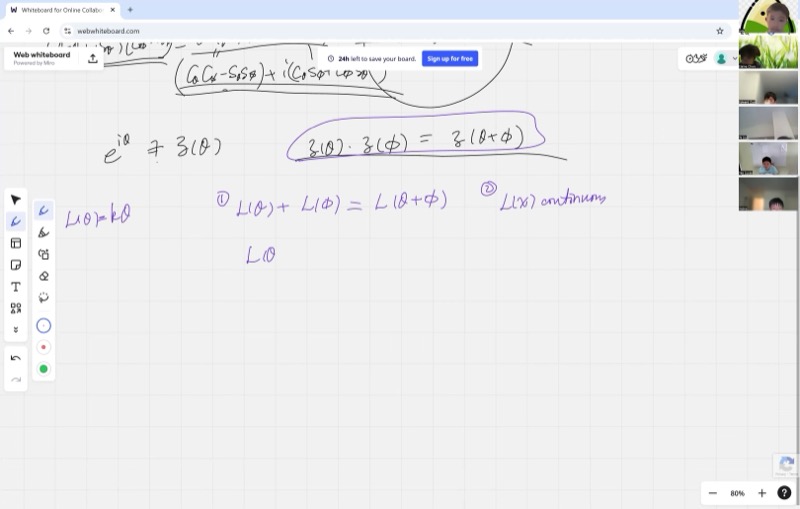
- Additive functions satisfy \(L(\theta + \phi) = L(\theta) + L(\phi)\). If continuous, the only solution is \(L(\theta) = k\theta\) (a line through the origin).
- Multiplicative functions satisfy \(Z(\theta + \phi) = Z(\theta) \cdot Z(\phi)\). Taking the logarithm converts them to additive functions.
- Logarithms bridge multiplication and addition: \(\log(ab) = \log a + \log b\).
- Euler’s formula \(e^{i\theta} = \cos\theta + i\sin\theta\) follows from proving \(Z(\theta) = e^{k\theta}\) and determining \(k = i\) from the geometry of the unit circle.
- Continuity means nearby inputs give nearby outputs: for any desired closeness in output, you can find inputs close enough to guarantee it.
Part 1: The Multiplicative Property of Unit Complex Numbers
Define \(Z(\theta) = \cos\theta + i\sin\theta\), the unit complex number at angle \(\theta\).
From the angle-addition identities, we can verify:
\[Z(\theta) \cdot Z(\phi) = (\cos\theta + i\sin\theta)(\cos\phi + i\sin\phi)\]
Multiplying out and using \(i^2 = -1\):
\[= (\cos\theta\cos\phi - \sin\theta\sin\phi) + i(\cos\theta\sin\phi + \sin\theta\cos\phi)\]
\[= \cos(\theta + \phi) + i\sin(\theta + \phi) = Z(\theta + \phi)\]
So \(Z\) is a multiplicative function: adding the angles corresponds to multiplying the complex numbers.
Let \(\theta = \frac{\pi}{3}\) and \(\phi = \frac{\pi}{6}\).
- \(Z\!\left(\frac{\pi}{3}\right) = \cos 60° + i\sin 60° = \frac{1}{2} + i\frac{\sqrt{3}}{2}\)
- \(Z\!\left(\frac{\pi}{6}\right) = \cos 30° + i\sin 30° = \frac{\sqrt{3}}{2} + i\frac{1}{2}\)
Multiplying:
\[Z\!\left(\frac{\pi}{3}\right) \cdot Z\!\left(\frac{\pi}{6}\right) = \left(\frac{1}{2}\right)\!\left(\frac{\sqrt{3}}{2}\right) - \left(\frac{\sqrt{3}}{2}\right)\!\left(\frac{1}{2}\right) + i\left[\left(\frac{1}{2}\right)\!\left(\frac{1}{2}\right) + \left(\frac{\sqrt{3}}{2}\right)\!\left(\frac{\sqrt{3}}{2}\right)\right] = 0 + i \cdot 1 = i\]
And indeed \(Z\!\left(\frac{\pi}{2}\right) = \cos 90° + i\sin 90° = i\). It checks out!
Part 2: Proving Continuous Additive Functions Are Linear
Before tackling \(Z(\theta)\) directly, we prove a foundational result about additive functions.
Theorem. If \(L: \mathbb{R} \to \mathbb{R}\) is continuous and satisfies
\[L(\theta + \phi) = L(\theta) + L(\phi) \quad \text{for all } \theta, \phi \in \mathbb{R},\]
then \(L(\theta) = k\theta\) for some constant \(k\).
Step 1: Find \(L(0)\).
Set \(\theta = \phi = 0\):
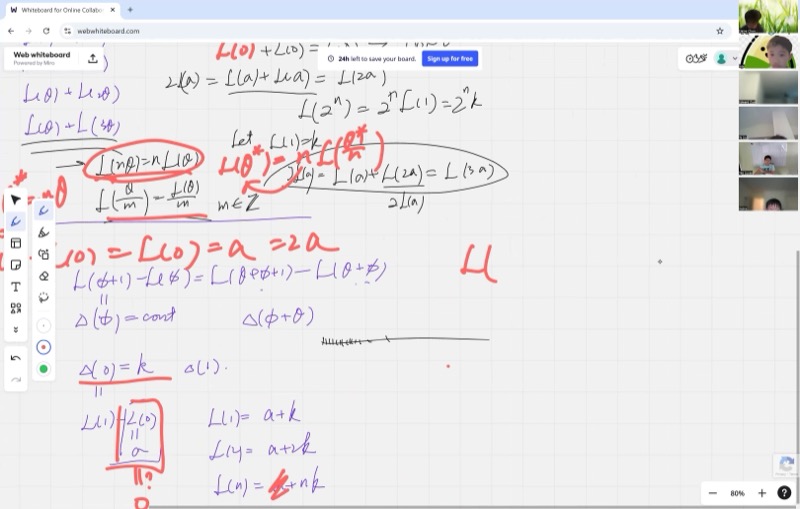
\[L(0) + L(0) = L(0) \implies 2L(0) = L(0) \implies L(0) = 0\]
So the function passes through the origin.
Step 2: Prove \(L(n\theta) = nL(\theta)\) for positive integers \(n\).
Set \(\theta = \phi\): \(L(2\theta) = 2L(\theta)\).
Then \(L(3\theta) = L(\theta + 2\theta) = L(\theta) + L(2\theta) = L(\theta) + 2L(\theta) = 3L(\theta)\).
By induction: \(L(n\theta) = nL(\theta)\) for all positive integers \(n\).
Step 3: \(L\) is an odd function.
Set \(\phi = -\theta\):
\[L(\theta) + L(-\theta) = L(0) = 0 \implies L(-\theta) = -L(\theta)\]
So the result extends to all integers: \(L(n\theta) = nL(\theta)\) for \(n \in \mathbb{Z}\).
Step 4: Extend to rational multiples.
From Step 2, \(L(m \cdot \frac{\theta}{m}) = m \cdot L\!\left(\frac{\theta}{m}\right)\), so:
\[L\!\left(\frac{\theta}{m}\right) = \frac{1}{m} L(\theta)\]
Combining: \(L\!\left(\frac{n}{m}\theta\right) = \frac{n}{m}L(\theta)\) for any integers \(n, m\) with \(m \neq 0\).
Setting \(\theta = 1\) and calling \(k = L(1)\):
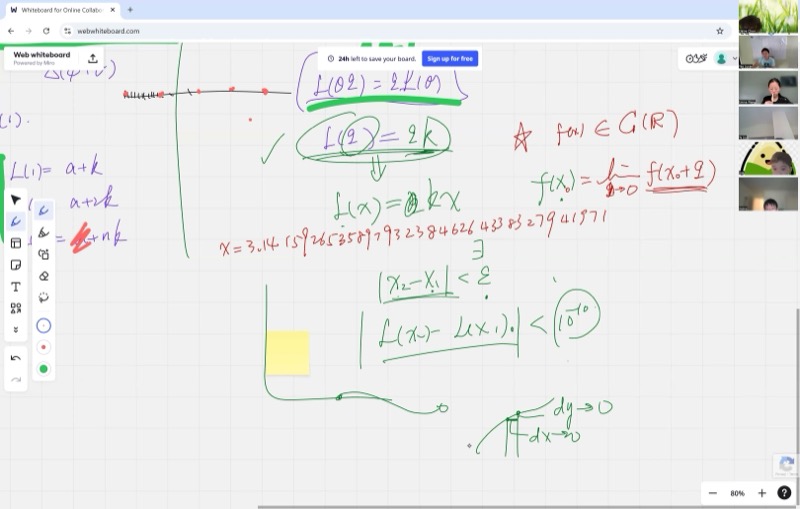
\[L(q) = kq \quad \text{for all rational } q\]
Step 5: Use continuity to extend to all reals.
Every real number \(x\) is the limit of a sequence of rationals \(q_1, q_2, q_3, \ldots \to x\).
By continuity:
\[L(x) = \lim_{n\to\infty} L(q_n) = \lim_{n\to\infty} kq_n = k \cdot \lim_{n\to\infty} q_n = kx\]
Therefore \(L(x) = kx\) for all \(x \in \mathbb{R}\). \(\blacksquare\)
Part 3: What Is Continuity?
The proof above relied on continuity. Here is the rigorous definition.
A function \(f(x)\) is continuous at \(x_0\) if:
\[f(x_0) = \lim_{h \to 0} f(x_0 + h)\]
More precisely: for any desired accuracy \(\delta > 0\), there exists a tolerance \(\varepsilon > 0\) such that whenever \(|h| < \varepsilon\), we have \(|f(x_0 + h) - f(x_0)| < \delta\).
Consider a function that equals \(kx\) on all rationals but does something wild on irrationals (this is possible!). Such a function would satisfy \(f(x+y) = f(x) + f(y)\) but would NOT be continuous.
Continuity is the condition that rules out these “pathological” solutions and forces \(L(x) = kx\) to be the only answer. The rational numbers are dense in the reals – between any two real numbers there is a rational number – so a continuous function that is \(kx\) on the rationals must be \(kx\) everywhere.
Part 4: From Multiplicative to Additive via Logarithms
The unit complex number function \(Z(\theta)\) is multiplicative:
\[Z(\theta + \phi) = Z(\theta) \cdot Z(\phi)\]
To use our result about additive functions, we take the natural logarithm of both sides.
Let \(\log a = x\) and \(\log b = y\), meaning \(e^x = a\) and \(e^y = b\).
Then:
\[ab = e^x \cdot e^y = e^{x+y}\]
Taking the logarithm:
\[\log(ab) = x + y = \log a + \log b \quad \blacksquare\]
This is the fundamental property that converts multiplication into addition.
Define \(f(\theta) = \log Z(\theta)\). Then:
\[f(\theta + \phi) = \log Z(\theta + \phi) = \log\!\big[Z(\theta) \cdot Z(\phi)\big] = \log Z(\theta) + \log Z(\phi) = f(\theta) + f(\phi)\]
So \(f\) is additive! Since \(Z(\theta)\) is continuous (it traces the unit circle smoothly), and \(\log\) is continuous (for nonzero inputs), the composite \(f\) is also continuous.
By our theorem from Part 2:
\[f(\theta) = k\theta \quad \text{for some constant } k\]
Translating back from logarithm to exponential:
\[\log Z(\theta) = k\theta \implies Z(\theta) = e^{k\theta}\]
Part 5: Determining \(k = i\)
We have shown \(Z(\theta) = e^{k\theta}\), but what is \(k\)?
Consider an infinitesimal angle \(d\theta\) near zero. The power series gives:
\[Z(d\theta) = e^{k \cdot d\theta} = 1 + k \, d\theta + \frac{(k \, d\theta)^2}{2!} + \cdots \approx 1 + k \, d\theta\]
(Higher-order terms like \((d\theta)^2\) are negligible when \(d\theta\) is tiny.)
Now look at the geometry of \(Z(d\theta)\) on the unit circle:
- \(Z(0) = 1\) (the point \((1, 0)\) on the real axis)
- \(Z(d\theta)\) is displaced from \(Z(0)\) by a tiny arc of length \(d\theta\)
- This arc is essentially vertical (perpendicular to the real axis) when \(d\theta \approx 0\)
- So the displacement is \(i \cdot d\theta\) (magnitude \(d\theta\), direction \(90°\))
Comparing: \(Z(d\theta) \approx 1 + k \, d\theta \approx 1 + i \, d\theta\), so \(k = i\).
Therefore:
\[\boxed{Z(\theta) = e^{i\theta} = \cos\theta + i\sin\theta}\]
This is Euler’s formula.
Setting \(\theta = \pi\) in Euler’s formula:
\[e^{i\pi} = \cos\pi + i\sin\pi = -1 + 0 = -1\]
Therefore:
\[e^{i\pi} + 1 = 0\]
This single equation links the five most fundamental constants in mathematics: \(e\), \(i\), \(\pi\), \(1\), and \(0\).
Part 6: Summary of the Proof Strategy
The proof followed a beautiful chain of reasoning:
- Geometry \(\to\) The angle-addition formulas show \(Z(\theta)\cdot Z(\phi) = Z(\theta+\phi)\)
- Algebra \(\to\) Taking logarithms converts the multiplicative equation to an additive one
- Analysis \(\to\) The only continuous additive function is \(f(\theta) = k\theta\)
- Geometry again \(\to\) Examining infinitesimal rotations shows \(k = i\)
Each step uses a different branch of mathematics, and they all fit together to prove one elegant formula.
Cheat Sheet
| Concept | Formula / Definition |
|---|---|
| Unit complex number at angle \(\theta\) | \(Z(\theta) = \cos\theta + i\sin\theta\) |
| Euler’s formula | \(e^{i\theta} = \cos\theta + i\sin\theta\) |
| Euler’s identity | \(e^{i\pi} + 1 = 0\) |
| Additive function | \(L(x+y) = L(x) + L(y)\); if continuous, then \(L(x) = kx\) |
| Multiplicative function | \(Z(x+y) = Z(x)\cdot Z(y)\) |
| Logarithm converts \(\times\) to \(+\) | \(\log(ab) = \log a + \log b\) |
| Continuity at \(x_0\) | \(\forall\,\delta>0,\;\exists\,\varepsilon>0\) such that \(|h|<\varepsilon \Rightarrow |f(x_0+h)-f(x_0)|<\delta\) |
| Power series for \(e^x\) | \(e^x = 1 + x + \frac{x^2}{2!} + \frac{x^3}{3!} + \cdots\) |
| Angle addition (cosine) | \(\cos(\theta+\phi) = \cos\theta\cos\phi - \sin\theta\sin\phi\) |
| Angle addition (sine) | \(\sin(\theta+\phi) = \cos\theta\sin\phi + \sin\theta\cos\phi\) |