Graphing Cubics, Polynomial Long Division & Root Multiplicity
Lecture Video
Background
We have previously studied how to graph quadratics — finding the vertex, axis of symmetry, and intercepts to obtain a parabola. What happens when the highest power of \(x\) is three instead of two? Cubic polynomials produce S-shaped curves that can have up to two turning points, and their graphs have a beautiful point symmetry (rotational symmetry of 180 degrees) instead of a line of symmetry.
This lesson presents a powerful, systematic method for sketching any factored polynomial by hand — the snaking method — and then extends it to rational functions with vertical and slant asymptotes. Along the way, we practice polynomial long division, which is the key tool for finding slant asymptotes and simplifying rational expressions.
- The Snaking Method: Factor the polynomial, mark all x-intercepts, label each root as single/double/triple, then “snake” the curve from right to left — crossing at odd-multiplicity roots and bouncing at even-multiplicity roots.
- End Behavior: The leading term \(a_n x^n\) determines what happens as \(x \to \pm\infty\). Start the snake from the right side using the sign of \(a_n\).
- Root Multiplicity:
- Odd power \((x - r)^1, (x - r)^3, \ldots\) — the graph crosses the x-axis.
- Even power \((x - r)^2, (x - r)^4, \ldots\) — the graph bounces (touches and turns back).
- Polynomial Long Division lets you divide one polynomial by another, producing a quotient and remainder — essential for finding slant asymptotes of rational functions.
- Symmetry of Cubics: Every cubic \(y = ax^3 + bx^2 + cx + d\) has a center of symmetry at its inflection point.
Key Video Frames
1. Graphing a Cubic: The Family \(y = x^3 + ax^2\)
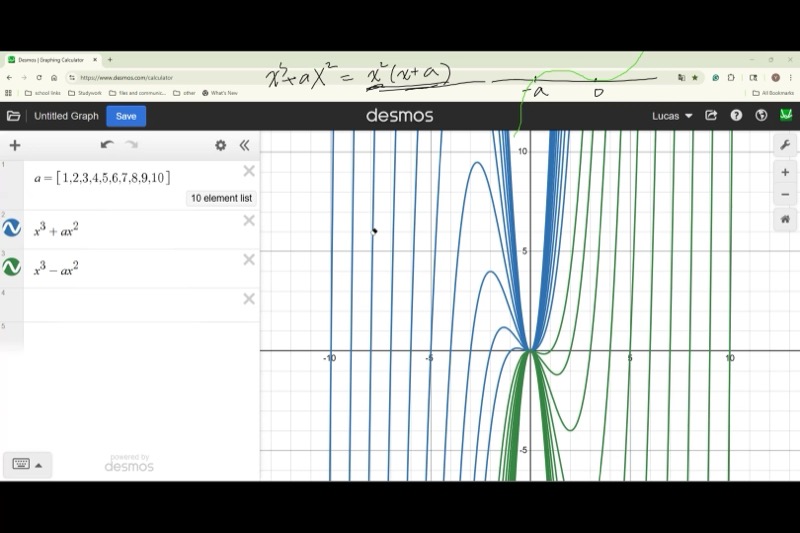
Consider the one-parameter family of cubics:
\[y = x^3 + ax^2\]
Factoring and Finding Roots
Factor out \(x^2\):
\[y = x^2(x + a)\]
This immediately reveals:
- \(x = 0\) is a double root (from the \(x^2\) factor)
- \(x = -a\) is a single root (from the \((x + a)\) factor)
A product equals zero when any factor equals zero. Setting \(x^2 = 0\) gives \(x = 0\), and setting \(x + a = 0\) gives \(x = -a\). The exponent on each factor tells you the multiplicity of that root.
Applying the Snaking Method
- Mark the x-intercepts: Place \(x = 0\) (double root, draw a bar) and \(x = -a\) (single root, draw a dot) on the number line.
- Determine end behavior: The leading term is \(x^3\) (positive coefficient, odd degree), so:
- As \(x \to +\infty\), \(y \to +\infty\) — start from the upper right.
- As \(x \to -\infty\), \(y \to -\infty\).
- Snake through the intercepts:
- Come down from \(+\infty\) on the right.
- At \(x = 0\) (double root): bounce — touch the axis and turn back up without crossing.
- Continue left to \(x = -a\) (single root): cross through the axis.
- Continue down toward \(-\infty\).
Explore this family of cubics — drag the slider for \(a\):
Finding the Turning Points
To locate the turning points (local max and min), take the derivative and set it to zero:
\[y' = 3x^2 + 2ax = x(3x + 2a) = 0\]
The solutions are:
\[x = 0 \quad \text{and} \quad x = -\frac{2a}{3}\]
As \(a\) varies, the x-coordinate of the non-origin turning point is \(x = -\frac{2a}{3}\), which is a linear function of \(a\). The set of all turning points traces out a straight line, not a curve! However, when you plug back into the original equation to get the y-coordinates, the locus becomes a cubic curve in the \((x, y)\)-plane.
2. The Snaking Method in Full Generality
The snaking method works for any factored polynomial. Here is the complete procedure:
Step-by-Step Algorithm
- Factor the polynomial completely.
- Mark all x-intercepts on a number line.
- Label multiplicity: single root (dot), double root (bar), triple root, etc.
- Start from the right: Use the leading coefficient and degree to determine whether \(y \to +\infty\) or \(y \to -\infty\) as \(x \to +\infty\).
- Snake through: At each root from right to left:
- Odd multiplicity (1, 3, 5, …): cross the x-axis.
- Even multiplicity (2, 4, 6, …): bounce off the x-axis (same sign on both sides).
Worked Example
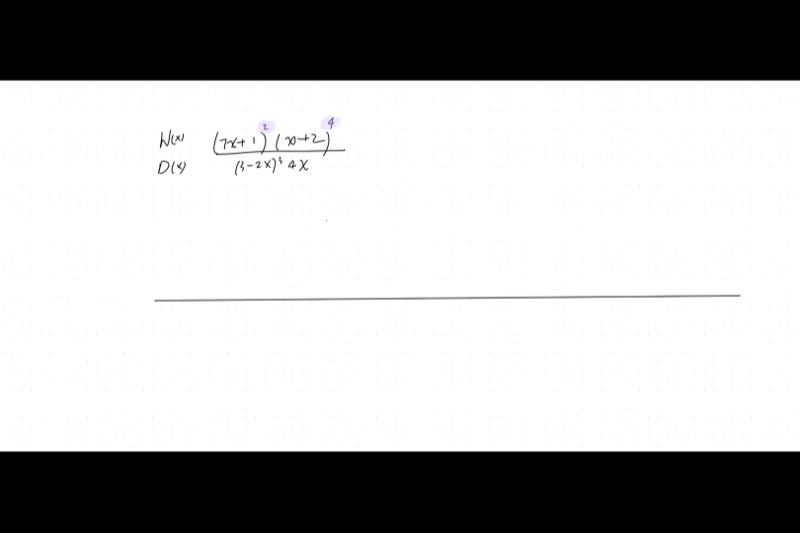
Step 1 — Roots and multiplicities:
| Factor | Root | Multiplicity | Behavior |
|---|---|---|---|
| \((3 - 2x)^3\) | \(x = \frac{3}{2}\) | 3 (odd) | crosses |
| \(4x\) | \(x = 0\) | 1 (odd) | crosses |
| \((7x + 1)^2\) | \(x = -\frac{1}{7}\) | 2 (even) | bounces |
| \((x + 2)^4\) | \(x = -2\) | 4 (even) | bounces |
Step 2 — Leading coefficient:
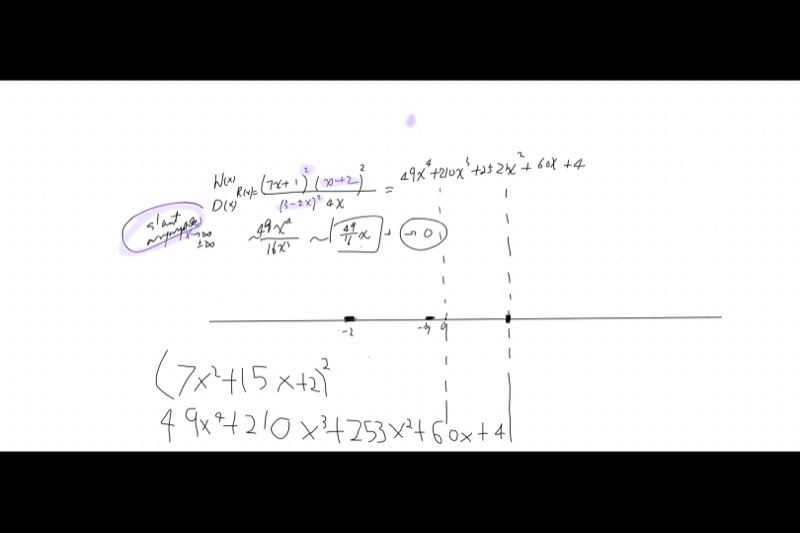
Expand the leading terms: \((-2x)^3 \cdot 4x \cdot (7x)^2 \cdot (x)^4 = (-8)(4)(49)(1) \cdot x^{10} = -1568x^{10}\)
- Degree 10 (even) with negative leading coefficient.
- Both ends: \(y \to -\infty\).
Step 3 — Snake from the right:
Start from \(-\infty\) (far right, below x-axis). Reading the roots left to right: \(-2, -\frac{1}{7}, 0, \frac{3}{2}\).
Starting from the right side at \(x = +\infty\) (where \(y \to -\infty\)):
- Approach \(x = \frac{3}{2}\): cross (triple root) \(\to\) now above x-axis
- Approach \(x = 0\): cross (single root) \(\to\) now below x-axis
- Approach \(x = -\frac{1}{7}\): bounce (double root) \(\to\) stays below x-axis
- Approach \(x = -2\): bounce (quadruple root) \(\to\) stays below x-axis
- Continues to \(x \to -\infty\) at \(y \to -\infty\) (consistent!)
3. End Behavior Reference
| Leading term | \(x \to +\infty\) | \(x \to -\infty\) |
|---|---|---|
| \(+x^{\text{even}}\) | \(+\infty\) | \(+\infty\) |
| \(-x^{\text{even}}\) | \(-\infty\) | \(-\infty\) |
| \(+x^{\text{odd}}\) | \(+\infty\) | \(-\infty\) |
| \(-x^{\text{odd}}\) | \(-\infty\) | \(+\infty\) |
For odd degree: the ends go in opposite directions (like the letter S or a backwards S).
For even degree: the ends go in the same direction (both up like a U, or both down like an upside-down U).
Then the leading coefficient tells you which way is “up.”
4. Polynomial Long Division
When graphing rational functions, we need to find slant (oblique) asymptotes. The tool for this is polynomial long division.
The Idea
Just like dividing \(157 \div 12 = 13\) remainder \(1\), we can write:
\[\frac{N(x)}{D(x)} = Q(x) + \frac{R(x)}{D(x)}\]
where \(Q(x)\) is the quotient (the polynomial part) and \(R(x)\) is the remainder.
As \(x \to \pm\infty\), the fraction \(\frac{R(x)}{D(x)} \to 0\) (when the degree of \(R\) is less than the degree of \(D\)), so the function approaches \(Q(x)\). If \(Q(x)\) is linear, that line is the slant asymptote.
Example from the Lesson
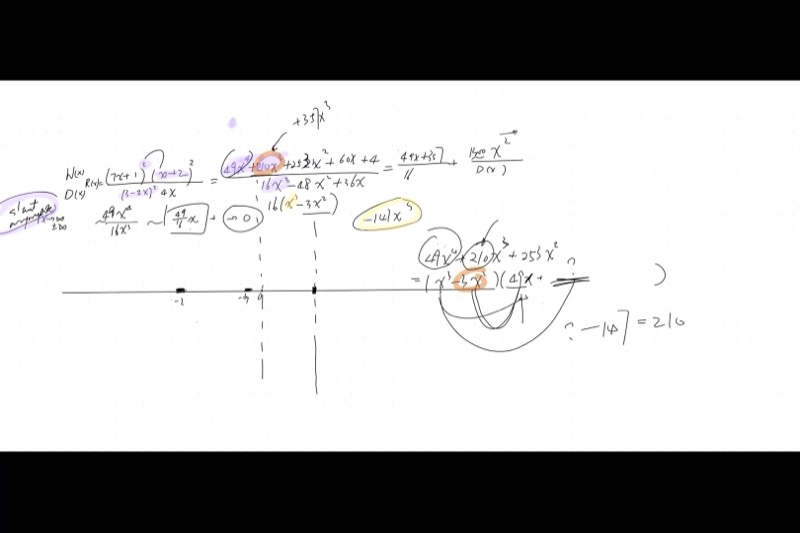
We need to divide:
\[\frac{49x^4 + 210x^3 + 253x^2 + 60x + 4}{16x^3 - 48x^2 + 36x}\]
Step 1: Factor out common constants from the denominator for easier arithmetic:
\[16x^3 - 48x^2 + 36x = 4x(4x^2 - 12x + 9) = 4x(2x - 3)^2\]
Step 2: Perform the division. Compare leading terms:
\[\frac{49x^4}{16x^3} = \frac{49}{16}x\]
Step 3: Multiply back and subtract:
\[\frac{49}{16}x \cdot (16x^3 - 48x^2 + 36x) = 49x^4 - 147x^3 + \frac{49 \cdot 36}{16}x^2\]
Step 4: Subtract from numerator to get the next term. Continue until the remainder has degree less than 3.
The result is:
\[Q(x) = \frac{49x + 357}{16}\]
This is the slant asymptote: \(y = \frac{49}{16}x + \frac{357}{16}\).
Key insight: The sign of the leading term in the remainder tells you whether the graph approaches the asymptote from above or below. A positive leading remainder coefficient means the graph is above the asymptote for large \(|x|\).
Explore polynomial long division interactively — see how the rational function hugs its slant asymptote:
5. Rational Functions and Asymptotes
When a polynomial factor appears in the denominator, its zeros become vertical asymptotes instead of x-intercepts. The snaking method extends naturally:
Rules for Vertical Asymptotes
| Denominator factor | Multiplicity | Behavior at asymptote |
|---|---|---|
| \((x - r)^1\) | Odd | \(y\) changes sign (goes from \(+\infty\) to \(-\infty\) or vice versa) |
| \((x - r)^2\) | Even | \(y\) keeps the same sign (both sides go to \(+\infty\) or both to \(-\infty\)) |
The logic is identical! At a root, an even power means \((x - r)^{2k}\) is always non-negative near \(r\), so the function does not change sign. At a vertical asymptote, an even power in the denominator means the denominator is always positive (or always negative) near \(r\), so the function blows up in the same direction on both sides.
Graphing a Rational Function: Complete Procedure
- Factor numerator and denominator completely.
- Numerator zeros \(\to\) x-intercepts (with multiplicity behavior).
- Denominator zeros \(\to\) vertical asymptotes (with multiplicity behavior).
- Find horizontal/slant asymptote by comparing degrees or doing long division.
- Determine whether the graph starts above or below the slant asymptote using the remainder sign.
- Snake through all intercepts and asymptotes from right to left.
6. Root Multiplicity: Crossing vs. Bouncing
See all three behaviors side-by-side:
The fundamental rule:
\[\boxed{\text{Odd multiplicity} \implies \text{crosses} \qquad \text{Even multiplicity} \implies \text{bounces}}\]
Consider the factor \((x - r)^k\) near \(x = r\):
- If \(k\) is even, then \((x - r)^k \geq 0\) for all \(x\) near \(r\). The sign of \(y\) does not change, so the graph touches the axis and turns back.
- If \(k\) is odd, then \((x - r)^k\) changes sign as \(x\) passes through \(r\) (negative on one side, positive on the other). So the graph must cross the axis.
Higher odd multiplicities (like triple roots) cross with a flatter approach — the graph lingers near the axis, creating an inflection-like shape.
7. Symmetry of Cubic Polynomials
Every cubic polynomial has a center of symmetry at its inflection point. For \(y = x^3 + ax^2\):
- The inflection point is at \(x = -\frac{a}{3}\)
- The graph has 180-degree rotational symmetry about this point
For a general cubic \(y = Ax^3 + Bx^2 + Cx + D\):
The inflection point is where \(y'' = 0\): \[y'' = 6Ax + 2B = 0 \implies x = -\frac{B}{3A}\]
Plug this x-value back into the original equation to get the y-coordinate.
The point \(\left(-\frac{B}{3A},\; y\!\left(-\frac{B}{3A}\right)\right)\) is the center of symmetry.
This means if you rotate the entire cubic graph 180 degrees around this point, you get the same graph back.
Cheat Sheet
Polynomial Graphing: The Snaking Method
| Step | Action |
|---|---|
| 1 | Factor the polynomial completely |
| 2 | Mark all x-intercepts on a number line |
| 3 | Label each root: single (dot), double (bar), triple, etc. |
| 4 | Determine end behavior from the leading term |
| 5 | Start from the right and snake through: cross at odd roots, bounce at even roots |
Root Multiplicity Quick Reference
| Multiplicity | Graph behavior | Visual |
|---|---|---|
| 1 (single) | Crosses straight through | \(\nearrow\!\!\searrow\) |
| 2 (double) | Bounces (touches and returns) | \(\cup\) or \(\cap\) |
| 3 (triple) | Crosses with flat inflection | S-shaped at root |
| 4 (quadruple) | Bounces with flat bottom | Flat \(\cup\) or \(\cap\) |
Polynomial Long Division
\[\frac{N(x)}{D(x)} = Q(x) + \frac{R(x)}{D(x)}\]
- \(Q(x)\) = quotient (the asymptote if it is linear)
- \(R(x)\) = remainder (determines above/below approach)
- Match leading terms, multiply back, subtract, repeat
Rational Function Asymptotes
| Degree comparison | Asymptote type |
|---|---|
| \(\deg(N) < \deg(D)\) | Horizontal: \(y = 0\) |
| \(\deg(N) = \deg(D)\) | Horizontal: \(y = \frac{a_n}{b_n}\) |
| \(\deg(N) = \deg(D) + 1\) | Slant: \(y = Q(x)\) via long division |